
Seattle’s music scene over the last eight years has, arguably, been resting in a dormant place (apart from the continual assertion that we had nothing to do with Nickelback). The EMP is now old news, the era of grunge has come and gone, and the music media rarely dare to tackle the dreary weather. The apparent latent state of Seattle’s music scene appears as a throwback after decades of strong recognition on the national and international landscape.
“Seattle hasn’t had an identity for awhile… there’s a void right now,” Tristan Beedon said, bassist for indiepoprock band Edison Orange (see Madonna meets the Pixies).
However, while a commercial identity may be missing, the presence of a rapidly developing trend appears to be reaching a boiling point: a resurgence of 90’s antics and charisma is littered throughout the prominent music styles of Seattle.
“The 90’s are coming back… so many examples are sprouting up,” Andrea Hovel said, vocalist and guitarist for Edison Orange.
Similarly, Sola Oyelowo, MC for Irukandji, remarked on the hip hop culture of Seattle pulling inspiration from their old roots, namely Sir Mixalot. Mat Chandler, guitarist and backing vocals of Heavy Metal band Cascabel, identified Dillinger Escape Plan and Bach as the strong influences on the Seattle Metal scene.
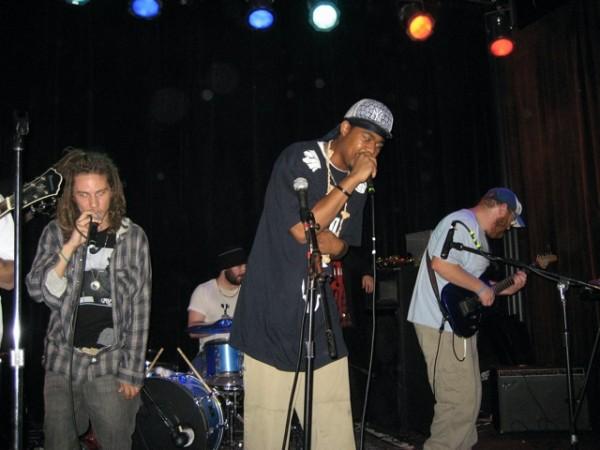
Members of the band Irukandji
Is it creative adaption that fuels this incorporation of the recent past, as opposed to purely nostalgia? Many believe that it is, indeed, an extension of Seattle’s artistic past and present.
“[Seattle] really appreciates good music… art will always come first… it’s refreshing to see legitimacy,” Garrett Gonvales said, vocalist for Cascabel.
Gonvales attributes much of the legitimacy of Seattle’s scene to the wealth of musical backgrounds that the city draws. The resulting fusion of styles and sounds “does not overly amalgamate” as he puts it. The influences are able to stand on their own, not to be blurred out of distinction in the process of incorporation.
The assertion of Seattle’s ability to avoid producing cookie-cutter scenes and bands means that we may be saved from seeing a confused army of Green Day and Vanilla Ice clones (otherwise known as unfortunate trend-setters who don’t know when to quit). One of the most comforting aspects of the Seattle scene currently is the believable incorporation of pre-contemporary sounds.
“Jazz is just one of those things; it’s beyond it’s time… people will always have to catch up with jazz,” Oyelowo said.
True to form the mother of 20th century musical invention is spreading through the underground of Seattle. Jazz is now such apart of the local scene that it is no longer surprising to see a trumpet, saxophone or even brush drum sticks weaved in with a multitude of ‘floating genres’ (a nice term mentioned by Hovel that I’ve decided to adopt).
But what is the point in Seattle’s scene when it comes down to it? Why bother understanding the hectic patchwork of sounds, tastes and cultures? Sola Oyelowo put it very nicely:
“Seattle’s one of those places where you can pick up a rock, throw it, and you’ll hit an artist… this city has more talent than any large city in the US, there are more creative minds here than I’ve seen anywhere in the nation.”

Latest posts by Daniel Burnett (see all)
- Punk Rock Show @ Seattle’s Chop Suey - October 13, 2010
- Sunday night at Seattle’s Chop Suey: The Rift and Irukandji - October 4, 2010
- The Horde and the Harem at Seattle’s Chop Suey - October 1, 2010

