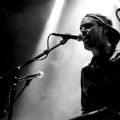
Austin - Until The Ribbon Breaks leaves strong first impressions. The name alone suggests weighty artistic ambitions, and if you’re savvier than me you might grasp the nostalgic allusion to tape that’s played to the breaking point. Their hip-hop beats and gothic synths seem relentlessly austere if you didn’t listen closer to the eponymous “Until The Ribbon Breaks” on the tail end of January’s debut record A Lesson Unlearnt. “I’ve been trying to guess the ending/And you’ll do just fine/So use me, taped and broken/Like your favorite old table/We could just play out through the summer/Until the ribbon breaks,“ sings Peter Lawrie-Winfield, and its irrepressibly sweet while not-exactly-sunny outlook brings to mind Robert Smith’s “Lovesong.” Similarly mixed is the band’s gloomy riff on Blondie’s “One Way or Another.”
Unlike Smith and The Cure, UTRB is not Lawrie-Winfield’s backing group, though he started the project alone in 2012, in Cardiff, Wales. His influence has been indelible and definitive—the group has maintained the fascination with film music that first inspired the project, and they’ve kept drawing from the hip-hop sources that distinguished Lawrie-Winfield’s indie-electronic sound. But Lawrie-Winfield insists that his bandmates get due credit, and that nobody mistakenly assume his agenda goes beyond pursuing what interests him.
“I’m going to clear this up once and for all in this interview,” he said, good naturedly, in our interview before one of the band’s recent sets at SXSW. “It was never a solo act. It was more of a project I just happened to start, really.”
True to form, the interview veered off-script. UTRB are fun people, who’d have thunk it, and it’s hard to resist shooting the bull. Eventually I managed to get them talking about the learning curve of collaboration, competitive freestyle, crappy stage lighting, and—you’ll have to read on to get this one—if it’s possible to meet a baby.
Will Jukes: Well to start, can I get everyone’s names and instruments?
Elliot Wall: Elliot, and I play the drums and do drum programming.
James Gordon: I play keyboards.
Peter Lawrie-Winfield: He’s [Gordon] done himself a huge injustice there; also drums, also bass, also backing vocals, and programming, and guitar playing, that’s all James.
WJ: And what about you?
PL-W: Oh, me! Singing, trumpet, guitar, keys, some drum programming. We all do a bit of everything.
WJ: It’s a little disorienting reading up on y’all—you started as Pete’s solo act, and then expanded to its current lineup. What influenced you to seek a band?
PL-W: That always comes up actually, and I’m gonna’ clear this up once and for all in this interview. It was never a solo act. It was more of a project I just happened to start, really. We needed a live show, for one, and James came on board with production and engineering, and then Elliot came on board to help with the live show. I never thought of it as “I am a solo artist.” It was just an evolution, and a natural one.
WJ: So you didn’t set out to be solo and then find that you needed a band, it just grew in that direction?
PL-W: Yes, exactly. It’s on the record now.
WJ: It’s on tape! So, to the rest of the band: you [Lawrie-Winfield] started out with a unique writing process, looking at film with the sound off and writing music that felt like it fit. Y’all [Wall and Gordon] seem to have embraced that method. What was that adjustment like?
EW: I actually stay clear of the studio until I feel like they want my opinion, and then I kind of come in and say “that’s shit” or “that’s amazing,” and they choose to either use what I’ve said or to ignore it.
JG: Yeah, usually we ignore it. [Wall laughs]. No, I think we both tend to take Pete’s lead there. I’ve always been a very visual person, in the sense that the music I produce and the music that excites me is kind of big, cinematic, otherworldly music, so my previous experience lends itself well to Pete’s aesthetic coming from film and that direction. But he’s definitely taking the lead.
EW: I think both of us have gotten more interested in editing and cutting video since this has started, so we’ve definitely jumped on Pete’s bandwagon.
WJ: Hearing about your interest in film music, I was wondering about the visual component to your live shows. How important do you think that is, and are you able to, and interested in, having a hand in designing that?
PL-W: Well, we have a lot of constraints unfortunately, either from the venue or financially, but it’s something we’ve thought about and the sky’s the limit, really. The shows I remember and stick in my head are things like DJ Shadow playing inside the video egg, and Radiohead playing behind these screens that are moving with the music. That visual component is what takes it to the next level. Or think about Nine Inch Nails where they’re silhouetted behind a screen then the screen disappears. That’s what pushes a show beyond being just some musicians with a few singles and toward being a multimedia event.
EW: We do carry some film equipment with us, and when we can we like to add that to our live sets.
WJ: Yeah, you can do cool stuff on a small budget—they had a great setup at Ghostface Killah last night.
PL-W: Does he come out in a dressing gown still? He used to come out in a dressing gown with loads of chains on.
WJ: No, not last night.
PL-W: Damn! He was wearing normal clothes?
WJ: Yeah, just normal clothes. So you didn’t miss that much apparently. But I asked only because a lot of the time I don’t see the point of stage lighting—it’s just like, intense blue light that makes it tough to photograph more than anything.
PL-W: It’s usually out of a band’s control, unfortunately. I think there (are) a lot of bands who’d like to do it themselves. For instance we just toured with London Grammar, and they do bigger shows in Australia than anywhere else, and they’re allowed a little more control over the production, and suddenly the show was transformed into this huge event. They had visuals and strings and amazing lighting, it was on a completely different level.
WJ: You mentioned DJ Shadow, and I’m wondering if he influenced the way you work—taking hip-hop beats and doing something a little different with them.
PL-W: It’s a huge part of what I do. DJ Shadow—for me, showed that hip-hop was bigger than a small scene in New York. He took the techniques of hip-hop production and applied it to a very different kind of music.
WJ: You mean like trip-hop?
PL-W: Yeah! Which is a horrible, horrible name, it’s so pretentious. But the music that falls under that umbrella is so amazing, like Massive Attack and Portishead. Dummy still sounds like it came out five years from now. It’s still pushing boundaries. I know that Jeff Barrow’s first love was hip-hop, and those early Portishead records were all sample based, and made on an MPC and then they played over them.
WJ: It’s always impressed me how hip-hop can take hold seemingly anywhere. Even if it’s in a very different form, like trip-hop.
PL-W: I think for a long time Britain found it difficult to rap. Now we’ve embraced our own version of it, we’ve got grime and stuff, but for a long time I feel like we were aping what we heard from the states and it didn’t work.
WJ: Running short on time so I can’t comment on that as much as I’d like to, but before I have to go, I was told to ask you if it’s possible to meet a baby.
EW: We got to the bottom of this yesterday I thought! Did you get this off Twitter?
WJ: No, your manager told me I should ask.
EW: He [Lawrie-Winfield] doesn’t agree, but I think we got to the bottom of this. You can meet a baby, because a baby is a someone, and a someone is a person.
PL-W: It’s been a debate that’s been going for a couple of years now, and I don’t know if you can meet a baby because I feel like a meeting has to involve a mutual understanding of what’s happening.
WJ: I agree, I think babies’ personalities are still developing and I think a meeting has to be a meeting of minds.
PL-W: Exactly.
We had to cut it off there, unfortunately, but I was able to catch their show later on. After dropping a debut record in January and playing a filled up SXSW schedule, Until The Ribbon Breaks are resting on their laurels for now. We’re holding our breath until a fall tour is announced.

Will Jukes
Latest posts by Will Jukes (see all)
- Dawes Matures With “All Your Favorite Bands” - June 2, 2015
- Communions Find Balance in New EP - June 2, 2015
- Wolf Alice Takes Austin Back to the 90’s - May 27, 2015