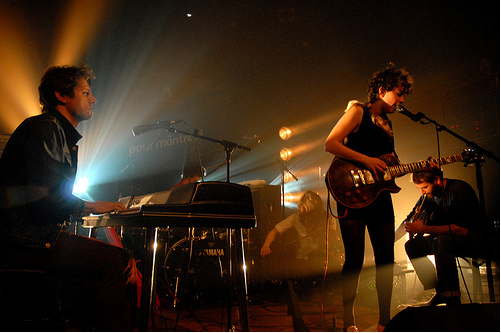
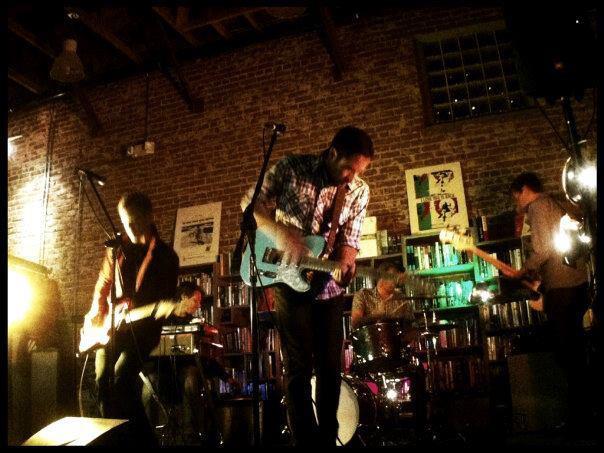
High Places are duo comprised of multi-instrumentalist Rob Barber and vocalist Mary Pearson (Photo: Hisham Bharoocha). The two have come far since their beginnings as a band almost six years ago, relocating from one coast to another, touring art spaces and DIY clubs all over the world, and most recently releasing their third full length, Original Colors, all the while absorbing every aspect of their journey. Their experiences have served as inspiration for their creative output, in addition to a well-documented path they’ve taken. The story of High Places could actually make a great documentary one day, but in the meantime, here’s a somewhat lengthy, yet substantial read from when I caught up with them during their recent run through Brooklyn, one of the band’s old stomping grounds.
Kelly Knapp: How is the tour going so far?
Rob Barber: It’s been really smart. It’s been good, but it’s been really smart as far as how it’s been set up. Our last album, we basically did North America, leaving from California, leaving our van in Philadelphia and flying to Europe, and then coming back.
Mary Pearson: We love touring, we love performing, but that’s a really long time to be away from home. Just having a couple days between legs of the tour makes a huge difference.
RB: We did the west coast and we came home for five days, and then we came out and did the northeast and Canada, and Midwest, and now we go for a little bit, and then we go to Europe. So it’s rather than basically trying to do it all in one shot, breaking it up a little bit.
MP: After like, five and a half years of doing the band, we’re finally figuring some things out.
RB: Yeah, I mean, we’ve toured a ton, and we still like touring, but we realize that we have to break it up or you start to look older.
KK: What kind of things do you do when you have an off day in a new city?
RB: Hiking.
MP: We go to botanic gardens a lot, especially when we’re in different countries. It’s really interesting to see native flora. And we like to eat. We’re both vegans, so we’re really into food. And coffee.
RB: Yeah we hunt for really good food. Hopefully not as much coffee. I’m trying to cut back.
MP: Yeah, we’re trying to mellow on coffee a little. Caffeine’s not always the coolest thing on tour.
RB: And trying to find stuff between cities, stuff that’s more rural and outdoorsy.
MP: We try to take photos of where we’re going, and document food that we’re eating. I like to try to make a little path, to show friends who are also on tour, who also like to eat nice stuff.
KK: I think that’s cool. I’ve looked at your blog, and it’s cool to have that visual of what you’re doing.
RB: It’s also for – we have some friends that we’ve toured with, and they also have the same diet choice we have, so it’s almost like leaving a trail for each other, like, this place has good falafel.
MP: A lot of that stuff ends up inspiring, like the photos and just the traveling and all of that ends up inspiring our art quite a bit.
KK: Did a lot of that inspire your new album?
RB: I think everything we’ve done has always been somewhat about traveling, and basically the experience of escaping. The second album was more about the personal condition, but the first and this last record – in different ways – tend to be more about transporting.
MP: Yeah, and I think being on the road, and being on an airplane, and getting that perspective, you really start thinking about your life. Traveling is really good for that. Touring is like…every day is sort of like Groundhog Day, in that you do sort of the same thing, so there’s this timeless quality and you can really analyze your life. I always come home with post-tour resolutions, like I want to cook more, or hike more. That sort of thing just really gets you to think about life, and it’s really good for artistic inspiration, I think.
RB: Being able to travel so much is definitely such a nice byproduct of this line of work, but at the same time, it sort of makes you appreciate a sense of home more too. When we first started the band, we lived here, and I had been here for a long time – most of my life – and basically my escape pod was touring. Now when I’m away, it’s kind of like my time to just be in this meditative (state), like I can’t do anything right now except just travel, play, travel, keep moving. So it kind of cleans you out, so when you get back home you feel really re-charged and inspired to work.
MP: And then daily life is kind of exotic too, like getting the newspaper and seeing my cats feels really great.
RB: Gardening, stuff like that. As opposed to coming home from tour here (NY), and I’d want to sleep for five days.
KK: So does L.A. feel like more of a home base?
MP: I think it’s easy to be really domestic in L.A. You can sort of – Rob always calls it choosing your own adventure – it really is like that. You can create your own world. I think most places are like that, but L.A. in particular doesn’t just have one identity. There are so many different neighborhoods and areas that you can really create your dream environment, and I think for us, that’s made us much more domestic than we’ve ever been. It was so fun being in New York, but sometimes you’d come home really exhausted after tour and be like, oh yeah I forgot, the pace of the city is really fast, and I don’t have much space to call my own here. Just being able to spread out a little bit, I swear there are more hours in the day. Maybe it’s just all the sunlight, but the pace feels really slow in L.A.
RB: That’s a big part of it. Here, we’d stay up all night all the time. We’d work all night on stuff, and you’re out late too, more often. And I think in L.A. it feels kind of sick to waste the day.
MP: At least for Rob and I. We’re more dramatic about really getting our money’s worth in L.A. and every hour of daylight we can get.
RB: Especially in the summer. Basically from dawn to 8-10 or 11 in the morning, the weather is perfect. And then it gets to the point where you’re in the desert. It’s not humid – and I’ll take dry heat over humidity any day of the week – but it gets to the point where you’re not going to go hiking at 1pm in July. You’ll perish. It’s like Abraham, you’re toiling.
MP: We made that video, “Alto Lugares,” that was shot at dawn. The song is basically talking about hiking at dawn, so it’s pretty literal, but it was really a practical thing. We were like, we can’t be out in the desert in the middle of the day, so we’ll have to leave at 5am and just shoot for as long as we can, until it’s sweltering.
KK: What about the difference in music scenes? What’s the major difference?
MP: I feel like right when we started the band in 2006, it was when the internet was really taking off, like the MySpace thing with bands. I remember that we were really floored, because we made one song and put it on MySpace, and then we played a show in Michigan shortly after that, and people were singing along. That was really weird at the time, but I feel like because of that, we felt a connection to bands in different places. So while there is a different scene in L.A. we felt connected even when we were in New York. But there are similarities. Here, we played a lot of warehouse-y punk shows in Brooklyn, and in L.A. there’s that venue, The Smell, that’s really similar. And just being all-ages friendly and not like a typical venue. That made it an easy transition, and a lot of our friends in both places travel a lot, so I feel like where they’re based matters less.
KK: What’s it like to come back and play shows in Brooklyn?
MP: It feels good. It feels like home, still. That’s how we got started playing, and we’ve always played with – we’re borrowing our friend’s speaker cabinets, but they’re just like ours, and we always bring our own PA. That got started because we played warehouse shows in Brooklyn, and you just never knew what sort of sound system you were going to get, for better or worse. We tried to just make that a constant variable. But both bands we’re playing with tonight are based here.
KK: You’ve played with them both before?
MP: Yeah, we’ve played with Matteah before, and we’ve played with Peter, who plays keyboards in Test House and various bands. He played with a band called Soiled Mattress and the Springs, and his latest band was Silk Flowers. There’s a lot of crossover, and I feel like there’s always been that between New York and L.A. Flights are relatively cheap and direct, and people split their time if they can, if they have that luxury. That’s kind of a dream; I’d love that.
KK: What about your new song “Senora.” How did the concept for that video come about?
MP: That was our friend Keith. He’s a new friend, but he had done a video for some friends who are in a band in L.A. called Hecuba. They’re really awesome, and he did a video for them that was like, dancing cats. It’s really great, actually. It’s pretty sassy.
RB: You have to be a cat person.
MP: He contacted us and was like, hey I’m friends with Hecuba, and I like you’re music; I want to do a video. So we got together with him, and he was telling us some ideas he had, and one of his ideas was to do a sort of Popeye-inspired video.
RB: Well, he gave us all these sort of high concept ideas, and we were kind of like, hmm…
MP: And then he goes, ‘you won’t like this idea, but I want to make this video sometime…’
RB: He’s like, ‘oh, I have this other weird one…I don’t know, I always wanted to make kind of like, a really graphic live action Popeye with reverse gender…”
MP: No, he didn’t say reverse gender.
RB: Oh, that was your idea. But he said that and we were like, we like it!
MP: Sold! And then I was like, can I be Popeye, please?
RB: I only thought of this today, but I had always made the joke that if I was ever in a movie I would want to get killed. Preferably by a ghost or something, or a monster.
MP: If I’m ever in a soap opera, I’d like to get killed off in like two episodes.
RB: But I always made that joke, because I’m not a very performative person. I’m like, you know I shouldn’t really be in it too much. I’m kind of awkward. But then today I was just thinking, ah man, I should have been killed. It would have been so great if at the end of the film you (Mary) killed me.
MP: You were one of like, three people who didn’t get killed.
RB: I know! It just would have been so good if my cameo was being killed.
MP: Especially at the hands of your band mate. That could be therapy for bands.
RB: Yeah, that could be like, role playing for bands.
MP: I’ve never actually wanted to kill Rob, I have to say.
KK: What about the evolution of your music in general. I remember first hearing you guys in 2008, when you had 03/07 – 09/07 out, and your sound then was very organic, eclectic, and experimental, and you could hear all these more traditional instruments in an electronic environment, and now you’re refining your sound even more.
MP: It’s sort of been an accident, I think. Just as we go along, we sort of figure things out a little bit. We’ve always liked to challenge ourselves, and I always think of it as a sort of trajectory that you’re traveling along and collecting experiences, and it’s always going to change your sound. To me, it all sounds like High Places, and I really hear the two of us in everything we’ve made, but it definitely has evolved and changed directions here and there, but I think that we’ve sort of been building on these same ideas. We’re still obsessed with the idea of taking acoustic and organic sounds and manipulating them in this more inorganic way, and just that sort of dichotomy is really interesting to us. I think we could explore it for another five years, easily.
RB: That too, and it’s also like, I’m not really a musician. I’m more of a visual artist. I’ve always make music and sound stuff, but I always treated it more how I treated visual work – very collage-like and layered, and lots of little parts and assemblage. That’s how our music really is; it’s basically assemblage-type artwork, just using sound. I also tend to think about the emotional color of some sound that I might make or come up with it. I hope it doesn’t sound hokey, but essentially what I’m getting at is that it’s sort of like…when you make a lot of work, sometimes you start to feel like fall in your comfort zone of a certain palette, and the way to challenge yourself is to throw out those tubes of paint.
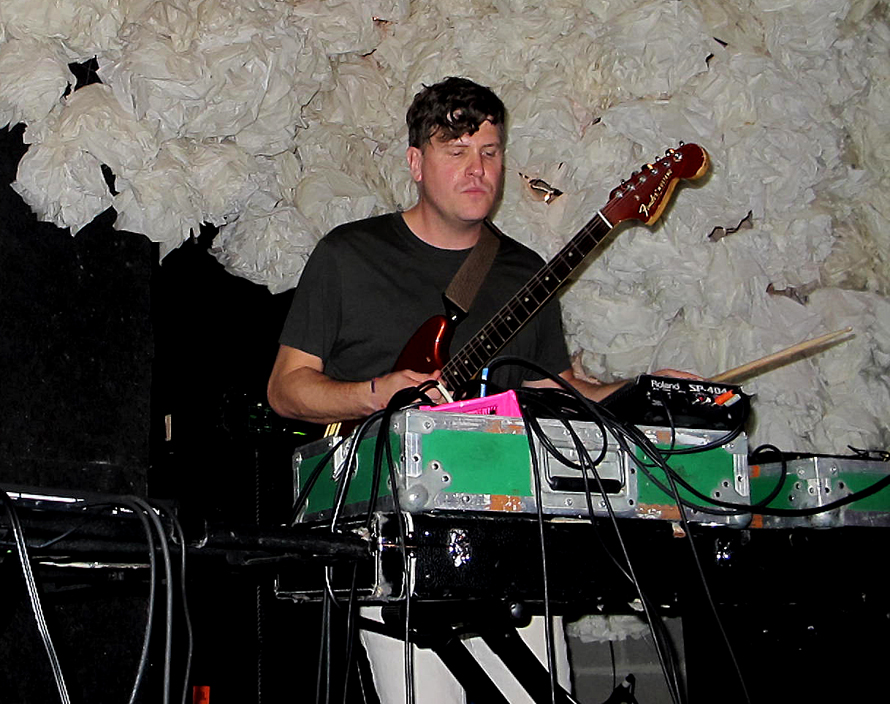
Rob Barber
MP: And the nature of experimentation is to try new things.
RB: And then start working with a different palette and challenge yourself on that level. And I felt like we used all these sort of homespun acoustic sounds on the first record; and we still kind of do – we still actually use a lot of the same sounds, but we color them differently.
MP: We’ve always been real immediate in just grabbing whatever’s in our line of vision and using that.
RB: Yeah, we don’t tend to use a lot of pre-fab gear. We tend to make a lot of the sounds still from like – it just sounds a little colder or more industrial at times now, because of just playing around with our comfort zone. I think if we kept re-creating the same songs, they would get distilled into something that wasn’t as interesting as the original thing. It’s not really something self-conscious, you just do it, out of being bored of the same materials.
KK: So even if you’re not still using mixing bowls or something, you’re still using layers and experimentation.
MP: Even on the last record, a lot of the percussive elements just started with us making sounds with our mouths and using that to make beats, and at the time we thought we were just recording ideas so we would remember them and re-create them later, and then we just ended using a lot of those sounds because we thought these sounded how we wanted them to. But the way we’ve always worked is just passing short recordings back and forth to each other, so we take one person’s very short, simple idea and then we add our own, and then back and forth, back and forth. So, it’s really hard for us to control our overall sound, because the other person is always taking it and pulling it in a different direction. It just always ends in some place that neither of us planned on. I think it’s hard for us to talk about genre and sound, because the other person gets in the way of it ever going in one specific direction, which is cool.
KK: Has that all translated to your live show as well, the same kind of evolution?
MP: Definitely. We’re constantly trying to figure out how to re-create the sounds in the best, most dynamic way.
RB: More physical, at least. Our approach is essentially like a photocopier or something. It’s essentially that with music, and trying to make it more…increase the physicality. We’re not against people who use laptops live, but for us, I’d rather be physically hitting something than trying to use a mouse pad. I don’t like the division between having a computer and having an audience, too. It’s just a personal preference.
KK: What’s the best thing about playing live, for you guys?
RB: For me, it’s really honestly playing with friends in different towns. Context is really important for us. We like playing in a lot of different environments on tour, and we actually play more art-type spaces as opposed to traditional music venues, and we like to do more of a combination of more underground shows – which is how we started here – and then maybe a traditional club environment and then maybe an art space. Just basically so you don’t have the same – back to the whole Groundhog Day analogy – because all clubs kind of look the same.
MP: And we’ve always been interested in this idea of High Places being an installation that we set up, and it takes on the environment of where it is, so it’s cool that one day we can play outside. Like, we did this outdoor show in Paris, in this sunken courtyard, and what we were playing just took on this totally different meaning than it would at a dark club at two in the morning.
KK: So do your songs require an elaborate setup, or how much equipment is involved?
RB: We’re on a budget, so there’s things out there that would maybe be easier to use for what we do, but we end up kind of cobbling stuff a bit more, like homemade in a sense. Like, we don’t use a click track or anything; we just try to play together. So it ends up being maybe more human – we have a sort of looseness so we can change things up a little bit so they’re a little different than the record.
MP: But we do use samplers and other electronics on stage, and I manipulate my vocals.
RB: But more in a sense of physically playing an instrument. Like, with a lot of electronics, they’re connected through midi clocking, and everything is sort of working off an essential brain. Our central brain is having to still make eye contact. We actually have to count, and there’s one song where there’s a couple breaks, and I always see Mary tapping during the break and then coming in. We don’t have en internal electronic clock that keeps us tied together. And that kind of gives it more of an element of chance.
KK: Back to talking about evolution, where do you see High Places in the future?
MP: I think the one thing we’ve learned about High Places is that it’s hard to predict what’s going to happen. We never thought that we’d still be doing this five and a half years later. I mean, we’re stoked, but there was no long-term goal for like, let’s be on MTV someday! But, I would think that for the next five years, we’re just going to do a lot of traveling, make a lot of music. I feel like we’ve always been working non-stop, but lately we’ve been so inspired to make new tracks, and I can’t wait to go home and make a bunch of stuff.
RB: Yeah, we’re trying to get away from the whole album, tour, album, tour, cycle that we’ve been doing for a few years. We want to make singles and just make things always, rather than being unproductive for six months while touring, and being more like, let’s break things up and make a single, or just drop a weird song for no reason other than to just do it, and be less tied into albums. There’s a lot of stock – you make an album, and it’s main thing is that there’s one single off it, and there’s a bunch of reviews of the album. When you’re making singles, it’s always just kind of like popping things out, and it’s a little surprise, and a little video pops up.
MP: And every time we make a song like that, we learn a lot about how we work and how we want to work, so it’s good for us.
RB: Definitely. You’re not locked into an album mentality when you’re trying to think about 11 or 10 songs.
MP: Yeah, writing an album’s like writing a novel. Writing singles is like a short story.
RB: You can have more fun with it, you can experiment, you can make a song that sounds really weird or really different. It’s just a lot more artistically free.

High Places are currently touring around Europe, where they are no doubt gathering more inspiration for whatever short stories they come up with next. Check their blog for photo updates on their adventures, and like them on Facebook for more news.