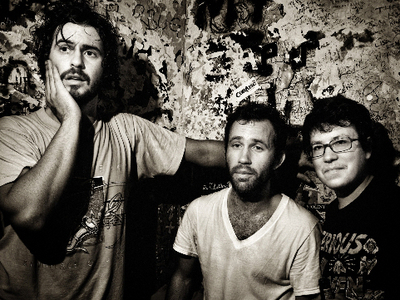
On the last Monday of March, I sat down with Dustin Wong before his show that night at Monster Island Basement. Nothing makes me appreciate a musician like hearing them talk about what makes them do what they do, and hearing Dustin’s philosophy on music, his influences, and what he finds inspiring was both impressive and refreshing. He knows his stuff, and in turn makes music of substance. Of course seeing him perform was the best part of the night, but our conversation at the top of the steps in Monster Island Basement’s stairwell was pretty cool too.
Kelly Knapp: I’ve done a little bit of research – just a little bit – on your backstory, and it seems you have a very personal philosophy on what making music is to you. Can you talk a little bit about that – where it comes from and what inspires you?
Dustin Wong: Sure, I don’t know where to start, but there’s definitely an output where I’m trying to make something that’s bigger than me. I’m trying to deal with something in me that’s bigger than myself. Kind of like projecting an ideal sound of how I can become, as a human being. Like working on the soul is the same as working on sound.

KK: Is it like an inner Zen thing for you?
DW: There’s definitely a meditative thing; just trying to get to a place in music where I can become a student of my own music – but not musically, as a metaphor.
KK: So it’s kind of a self-building thing, and finding out who you are through your music?
DW: Definitely, definitely. I’ve talked about the idea of looping, like when you have a tool like that you can really examine yourself musically. I always use the example of a four-way mirror, like something that facing each other and you can get to see yourself, see your profile.
KK: And it just goes on forever.
DW: It goes on forever and you just see yourself smaller, and then you realize that the environment around you is much bigger than you.
KK: I read something about how since you can’t explore space, you’re exploring—
DW: The inner space.
KK: Yes! That’s it.
DW: Yeah. That’s that, yeah. I also just started doing tarot readings. I see that as a mirror of the psyche too. So, just trying different approaches…like right now, I’ve kind of been sensing the frailty of my body, where my hands are starting to hurt more and more as I’m playing music, and it’s like well, if music is gone then what reflexive material would I go to? So I’m having this as like if I can’t play music anymore this is something I can go to.
KK: Or would you just switch – because you primarily play the guitar – so would you pick up another instrument?
DW: Well also, it doesn’t even have to be music. It can be the tarot or whatever. Or if it’s a place that I can’t go with music, I’ll have to choose something else.
KK: In your songs there’s a lot of layers and looping. What’s the most layers you’ve ever put into a song?
DW: How many layers? There’s one song…I can try counting…(slowly) 1,2,3,4,5,6,7,8,9,10,11,12,13,14. 14 loops.
KK: All guitar loops.
DW: All guitar loops. 14 loops on top of each other. But I’m just counting from this one particular song that I think has the most layers.
KK: So it could be more?
DW: It could be. It might be less but it could be more. Something like that.
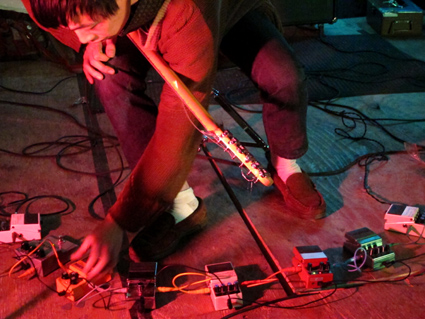
KK: What’s recording that like? What’s the process you have to go through?
DW: I just have everything set up just the way I perform at home, so I just write as I’m writing live. The more I’m developing these songs it’s definitely taking longer. Before, it would be one, maybe two good days of writing and I would be able to write a song. Now it’s taking like a week or two.
KK: Sounds like it would be very involved.
DW: Yeah, it’s a lot of geeking out.
KK: Haha, you sit there and fiddle around, then you’re like, oh I like that, alright loop that.
DW: Right, right, this feels good.
KK: This works, this doesn’t, delete.
DW: Exactly.
KK: What’s your process for composing? Does inspiration just strike you and you have to record it, or do you actively play around to find it?
DW: I’ve been doing this process where I’ll start with an idea and build it, and I’ll record onto my computer whatever idea I had. Recently my computer’s been acting weird, so I stopped doing that, which I like a lot better because what I tend to do when I record, I just listen until it dies. You know, it dies in my mind. And sometimes it’s harder to go back to it if the song’s already dead.
KK: And you’re not in that place anymore.
DW: Yeah, it’s just like I killed it by listening to it too much. But at the same time, when a song dies on you, you understand the shelf life of the song. Like how many times will I play it and be like, uummm on to the next, you know? Maybe I’m just trying not to go there right now. I’m not trying to expedite that process, just trying to settle down a little and write a little slower, meticulously.
KK: See if it sinks in and stays.
DW: Yeah exactly.
KK: Do you have a massive archive of halfway done songs that you might go back to?
DW: There’s a bunch of those. I would listen to them back and appreciate it, but I wouldn’t go back into it.
KK: So you don’t re-use anything.
DW: Well, there’s ideas that are used. The peers that I talk to about music in Baltimore, like my friend Matt – we used to be in a band called Ecstatic Sunshine together – we would meet maybe once a week and talk about music, and we kind of got to this resolution where we were like…or maybe I was the only one resolving this…but I think we were working on something where we were trying to be on the cusp of cliché and wit; just that border. Clichés can work so well, just like how Warhol used it in pop art. It’s these cultural landmarks that you can be like, oh yes, I do remember that. I remember that melody from this prior genre from years ago, or something. It can work as a ladder for something that’s not necessarily revolving around that idea, but just as a hint to travel to another place. Does that make sense?
KK: Kind of, because clichés are clichés because they’re true, they’re just overdone. I could see where you could stem something from that because it’s still truth and reality, but then you take it to another place.
DW: Yeah, or even a figure of speech can be a cliché, but it can resonate a lot of truth. You can be like, oh yeah, that’s the period mark for the situation.
KK: Ok. So, you’ve been in Ecstatic Sunshine, and you’re known for being in Ponytail. Was going solo a natural process away from that, or what lead to you doing your own thing?
DW: I was making music a lot by myself while I was in those bands, it was just that I didn’t play them publicly until my friend told me that I should. Without that encouragement I don’t think I would have.
KK: Do the songs translate the way you want them to live, or do they sometimes take on a life of their own?
DW: There isn’t much translation because it’s being played like it’s being played live. It’s being written live so I’m choosing how it should sound live, versus somebody who writes on a computer; they’ll have to figure out how to perform it afterwards. I try not to do that because that’s how I started. I used to write music on the computer and then learn how to perform it, so I’ve made a conscious decision that I was going to write live from then on, and just not have to deal with that.
KK: And you just remember, every time, the right sequences.
DW: Yeah, it’s all based on memory.
KK: You’ve also collaborated with several different artists. Who have you enjoyed working with the most?
DW: You know, what’s been the most fun is post-Ecstatic Sunshine. I collaborated with Matt afterwards, and the first thing we did was just an improvised show for my first record release. We just winged it the whole 40-minute set, and it was really fun. It didn’t have to be like, I have to play this part or this melody; we were just rolling with it. After that we started writing songs for Christmas time. We would email songs to friends…you might get one because you’re in my contacts now, for this year.
KK: Haha, ok! Send it over.
DW: So, yeah. This year we did “Sleepwalk” and “Blue Moon.”
KK: I love “Sleepwalk.”
DW: Yeah, yeah. Really good song.
KK: Santo & Johnny, right?
DW: Yeah!
KK: My dad had that vinyl record of theirs, and I kind of stole it from him.
DW: Yeah, that’s great. And it like, those songs especially – like Santo & Johnny – it has a very impressionist vibe to it, just like Satie or Debussy. The melody triggers a nostalgia that’s not cultural. It’s something that’s before that, and that’s something essential.
KK: Who have you learned from the most?
DW: Oh, everybody. Matt, Ken, the guitar duo I used to be in before Ecstatic Sunshine with my good friend. I’ve picked up a lot of stuff from everybody that I’ve worked with.
KK: You’ve also done extensive touring with your other bands, and by yourself?
DW: I’ve done one national tour by myself. I’m going to go on a European tour in about a week.
KK: What’s touring around the world been like? Do you have a favorite place you’ve played?
DW: I love France. I love traveling there, and just the language, the food, and the people. Just lovely. That’s why I asked my booking agent for more French dates.
KK: (laughs) I need a minimum of five dates in Paris…
DW: Actually, I have more. Not in Paris, but all over France.
KK: Who are your major influences?
DW: I would say…there’s a lot. The Beach Boys, Robert Fripp, Brian Eno, Joe Meek, Phil Spector, Terry Riley, Steve Reich, Phillip Glass. All those good things.
KK: What’s your favorite thing about playing live?
DW: I love it when I can feel the attention of the audience, of the concentration of being involved by listening. When I feel that it feels great. And obviously, when the music is doing what’s it’s supposed to for me, it makes me happy. It’s like if I’m feeling it, I’m sure somebody’s feeling it out there.
KK: Have you ever had a bad show?
DW: What would be a bad show is when my amp broke on stage while I was playing. That would be a bad show. Or if my guitar broke. That happened a couple times the last tour. My guitar just shut off while I was playing, and my amp just fizzled. It’s that uncontrollable stuff that kind of bummed me out, but there are also lessons in there as well.
KK: What’s next after your tour?
DW: Hopefully I’m going to do another record. I have an album already that’s already kind of ready to be recorded, so I’m going do that, keep writing music, and just learn.
KK: Your last album was Infinite Love?
DW: Yeah.
KK: And there was a DVD with that. Did you plan on that from the beginning?
DW: Well, I studied film in California for a couple years, and I mainly did that in Baltimore as well, during school. A good friend of mine and I were working on videos and I proposed to him that we should try making a whole piece for the album, so we got together. We had a bunch of footage that had already been accumulated, so we worked through those, then we shot new footage and put it all together.
KK: And your music is the soundtrack. Seems like a natural extension.
DW: Yeah, I feel really good about it.
KK: Good! I haven’t seen it but I know it was a double disc, “Brother” and “Sister.” You did the same thing but variations.
DW: Exactly. It’s the same until the halfway point, then they both go in their own direction. Then at the end they come back together.
KK: Do you use both for the DVD?
DW: Yeah there’s an option where you can watch the other version with it. There’s parts that doesn’t really sync up, but it kind of works.
KK: Did you film around the city?
DW: Yeah in Baltimore.
KK: What brought you to Baltimore? You grew up in Hawaii, lived in Japan…
DW: …and then I was in California. I visited my friend in Baltimore during a spring break, and I just fell in love with the city. I just felt this…I could sense the potential of the city when I got there, and I think a lot of other people sensed it too, because I think like Dan Deacon moved there the same year I did…it was just like a perfect place to create. Rent is low, there’s a lot of interesting people – interesting people that nobody knows about, that are brilliant. You know, you have these people that are secret, that you can go to.
KK: Does that seep into your writing, where you are at the time?
DW: Oh yeah. Just like bouncing different ideas off people, hanging out with different people there. It’s inspiring.
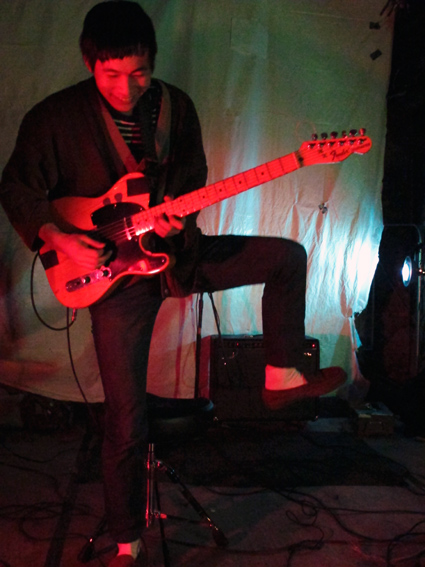
I think it’s probably also a given that Dustin Wong inspires the people around him too. I caught his show later that night, and there was no doubt that the crowd was connecting to his music just as much as he was. Even when the venue lights flickered to signal wrapping up the set, no one moved and he played on. In fact, everyone felt it so much that Dustin did his first solo encore. The energy was so good that he even stood up and danced. Dustin’s show was one that I am immensely happy I got to see, and I can’t wait to see where he goes from here.
Dustin is currently getting his France fix on his European tour (I counted 9 dates), interspersed between several countries with almost a show every night. He’ll be back in the states in May, with another Brooklyn show at Silent Barn on May 18th. You can also grab his Infinite Love double CD/DVD over at Thrill Jockey.