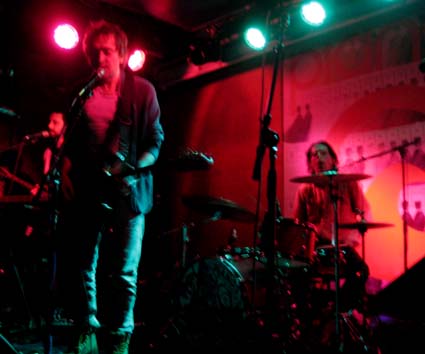
There are so many aspects of Grandchildren that it’s almost too hard to keep track, but much can be learned from them if you pay close enough attention. I sat down with four of the members – Roman Salcic, Aleks Martray, Adam Katz, and Tristan Palazzolo – in the upstairs lounge of Pianos, and these guys swapped stories just as well as they swap instruments on stage. I learned so much about West Philly’s DIY scene that I almost feel like I was there, and they had me laughing with them about their most memorable tour stories with Seabear. This is a group who respects their predecessors as well as contemporaries, and will no doubt keep gaining respect themselves.
Kelly Knapp: Who is Grandchildren?
Roman Salcic: We’re a band from Philadelphia – a six piece from West Philadelphia.
KK: Where did the name Grandchildren come from?
RS: I came up with the name, because I thought it was really cool, and I just thought it was a really cool sounding name, and I thought that it was really easily relatable. Everybody’s a grandchild, and I felt like it applied to our musical sensibilities too, because we are influenced by the music of our grandparents, our parents; it’s a generational thing. It stuck as a name, because ultimately, I thought it was pretty good.
Aleks Martray: It started to make more sense over time too, because we became a bigger and bigger band with more members – it sort of evolved into a sixpiece and it was like the idea of grandchildren who want to be in a band but just kind of took it over– the name proceeded it, so it’s kind of like a self-fulfilling prophecy thing. Our whole philosophy is incorporating everything our grandparents listened to, everything our parents listened to, everything we grew up with as kids, everything we like now, but just not boxing ourselves into any genre and listening to a lot of different music, experiencing a lot of different cultures, and just letting that all come through.
RS: There’s also this whole idea that Grandchildren are the newest generation, this whole thing that’s like, the world belongs to our children.
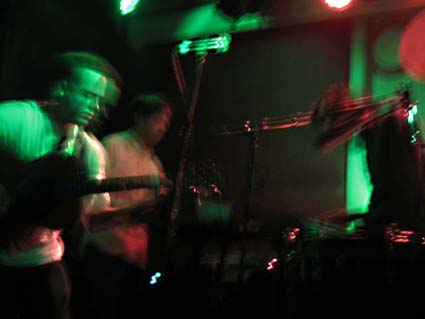
KK: In your live show, you all switch between instruments. Do you have a choreographed dance down to a science?
RS: I wouldn’t call it a dance, but it’s almost like you have to map out the stage before the show. You know the distances between certain things so you can have enough time to pull off your next part. Like, I have to run from a keyboard to a mic where I whistle, and if it’s too far I might have to cut off that last keyboard note so I can get there in time so the part flows.
AM: It’s not as slick as the Jackson 5 or The Temptations, or anything like that.
KK: So Aleks, you were the main songwriter in the beginning, and you lived in a house called Danger Danger that was also a venue. Is that how you all met?
AM: Yeah, I’ve known some of these guys for years and years, since like 2003. We met in college at an art school in Baltimore, and there was this sort of exodus with a lot of artists going to Philly. I was playing in a band with these guys loosely, but commuting back and forth from Baltimore to Philly, because I was the last one to move to Philly. I was writing in Baltimore and practicing in Philly, arranging stuff in my head in the car on the way back and forth. I didn’t really live anywhere, I was kind of all over the place, doing work in Central America, just traveling a lot. I was picking up a lot of music, like I went to Cuba and got a lot of music and was writing a lot. And then I finally moved to Philly and started a recording Project…I had never really recorded an album before, and I was writing songs on my acoustic guitar and then making beats – doing a lot of sampling. Roman and I would go do a lot of sampling in the backyard, around town, and we started to make beats with the samples. It was the first time that I had ever written through the recording process.
RS: It really changed the game for Aleks.
AM: And all six of us were living in this one house, and we were rehearsing, recording, having shows with 30-40 bands in a month or whatever in the basement, living room, bedroom, so the house was just a big spot of energy with music all the time. So as I was writing stuff I was handing off the demos to these guys and talking about it, and it just evolved from there.
KK: So did that influence the recording process as well, when you sort of had this home base and were surrounded by all these other musicians?
AM: It’s about the environment. We lived in West Philly, and there are a lot of bands but not a lot of places to play, so there are a lot of houses that started having shows, and for whatever reason, ours took hold was like THE place to play. We had really great bands play – everything from free jazz musicians that are like 80 years old to new emerging artists that right now are pretty big, but at the time nobody knew who they were. So it was sort of like a perfect storm, like the right place and time to be, and the music evolved from that.
KK: What are some of the bands that played there?
RS: Marshall Allen from Sun Ra, Genghis Tron, Big A Little A…
AM: Dan Deacon used to play the basement, Tickley Feather played her first show there…it was cool. I kind of miss that time because it was like, you just couldn’t get out of it. I was motivated to write every day. I used to be up writing music, recording music while there was a show going on in the basement, so I would write, record, take a break and go down and watch the show, get inspired and go back up.
RS: That was a really exciting time for a DIY scene in Philadelphia, and especially West Philly. I remember that I could go out on any night of the week to someone’s house, and at least a semi-cool show would be going on. There was a lot being offered, and kids were really enthused about throwing shows and developing the DIY scene in West Philly. It’s changed a little bit, I think it’s died down a little, but I also think it has something to do with regular venues stepping it up a little bit more in Philly and offering nicer spaces, better attitudes, and inviting better bands to play, so it’s shifted from playing basements to playing clubs a little bit more, but the DIY scene still is still alive. It’s also changed from West Philly being the hub of it to being more spread around town, where there’s other spaces like The Ox or Pterodactyl.
AM: Plus, it’s just like any scene, I think. Bands evolve out of the scene and underground shows once those bands start doing well for themselves. They’re on tour six months out of the year, like we’re on tour all the time. Like all the Wham City bands of Baltimore – the ones who did well are on tour, so less happens locally, but other people pick up the ball.
KK: And you guys just finished a tour.
AM: Yeah, it was about a month long U.S. tour to California and back. The longest leg of it was with Seabear.
KK: I love Seabear! They’re so cute.
RS: They’re adorable!
AM: Their accents are adorable.
RS: Their accents! Oh my god!
AM: And they were really fun to hang out with, like really beautiful people. Really fun and silly, and irreverent.
KK: Are they going to invite you to play in Iceland sometime?
AM: Yeah, they are. It’s just a matter of making it out there.
RS: We have to figure out this U.S. thing first.
Tristan Palazzolo: They all have kids.
AM: Most of them, yeah.
KK: I bet their kids are even cuter.
AM: Yeah, the kids have even cuter accents than the adults.
Adam Katz: They’re like Furbies.
KK: Do you guys have a most memorable moment on tour with them?
TP: Yes, definitely. The bass player, Tori (SP?) had his jacket accidentally stolen – kind of a shady situation – I don’t know how you accidentally steal someone’s jacket. It was given to this girl who it was way too big for…I don’t know, but they walked off with it and it had his passport and all his information in it and everything so he could get back home. Once we realized that was the case, the bars had let out – it was like 2am – we just started boltin’ down the road, hoping to run into them…just ran several blocks after them. We finally caught up with them and the group of people that had the jacket were extremely put off by this crazed Icelandic guy coming up to them, and not really explaining the situation, just like, (imitates Icelandic accent) “where is my jacket!” and going nuts. We did get the jacket home without any serious incidents, but it was really funny – the lot of us chasing down the street after them, hoping we would retrieve his passport. When we did, it was like this really great feeling of success and vindication.
KK: Now you’re in for good.
TP: Exactly. It was a bonding moment.
RS: We also had an arm-wrestling match with them.
TP: It was an arm-wrestling tournament!
AM: Let’s not speak of it.
KK: Did you guys lose?
TP: Yeah we lost big time.
AM: They might be scrawny, but they have Viking blood.
TP: They also had some serious technique.
KK: I just have one last question: What does the New Year hold for Grandchildren?
AM: Really just touring. We just released the album (Everlasting) in September, so we see the next year as just touring and being on the road all the time. We all really love being on the road; we thrive being on the road. There’s nothing I’d rather be doing. We’re always sort of working on new stuff, so that’s in the works, but I think right now we’re really proud of the songs that we have and the live show that we have, and we’re just going to push that as much as we can for the year and have a good time doing it.
If you get a chance to catch a Grandchildren show, I recommend taking it. Maybe they don’t have a dance, but they do have a well-choreographed multi-instrumentalist spectacle that deserves a captive audience.