
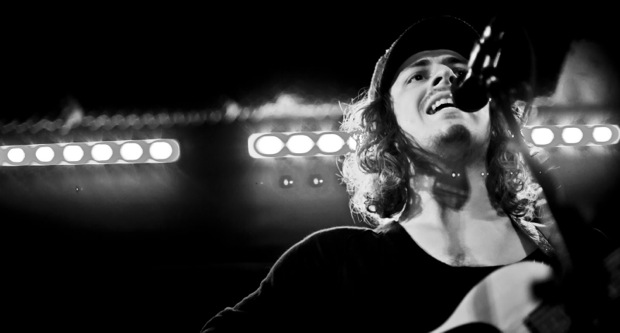
Nashville – Adam Stockdale is the fingerpicking virtuoso behind Albatross. I met up with Adam at Fido’s coffee shop in Nashville to talk with him about everything from immigration law to his ties with Mumford and Sons. The earnestness in Adam’s music is evident in his low-key personality. As he puts it, “I’m not doing this expecting riches. I’m just doing it because I love it.”
Can you give us a quick background for yourself? I know you’re from England…
Yeah, I grew in the midlands of England in a really small town. I played guitar since I was about four. My dad played guitar, and he had three brothers who all played different instruments too. We’d go out to my nan’s house, and there would be a drum kit in the garage. So I was quite lucky to always be around music. Even in a small town there were other people who played, so I was able to play with other musicians.
Where I grew up, you only really got cover bands, or function bands… I don’t know what you call them here. I did that while I was in school, and it was good fun. A lot of the other musicians were older so you get good quickly. But it was never really what I wanted to do. There was nowhere to play original music. So as soon as I left school, I went to Brighton and went to music college there. Brighton’s always been known for good music, you know the ‘70s mod scene and Quadrophenia and stuff.
It was the complete opposite of my hometown: where it would have been nice to play in a cover band to get a little bit of money, no one there would pay for covers. They only want original music, and they don’t want to pay for that either. So you do a lot of stuff for free beer. I was there off and on for about ten years, and I spent a little time in London. There’s a really good music community in Brighton. I moved there just after a bit of a boom. I moved there just before my eighteenth birthday, which was ten years ago. So The Kooks were just about to come out. There was a bunch of stuff that did well. It was exciting because there was a lot going on, but it kind of slowed down as I got there. The music college I went to was great because it brought a bunch of people to town that wanted to play music. But it also kind of over-saturated a place that was quite organic before that. But it was good living there. I met a bunch of other people who played music.
That’s great that you came from a family that supported your musical pursuits. What music has influenced you?
I didn’t hear much of what was going on in my era. My dad gave me big stack of records when I was young. It was Beatles records and Police records and Stones records. So I dodged the hurdle of having to figure it out for myself. It would have taken a bit longer to find that myself. I listen to a bunch of different things now. I specifically like songwriters like Michael Hedges and Jim Martin and Nick Drake and all the people that build rhythm and melody within the guitar playing. They made me appreciate different aspects of what makes a good guitar player
What spurred you coming to America?
I’ve been working in America since 2007. The first band I came with was The Kooks, and I’ve been back a lot since with Mumford and Sons. I’ve worked pretty non-stop for four years with them.
How did you get hooked up with Mumford and Sons?
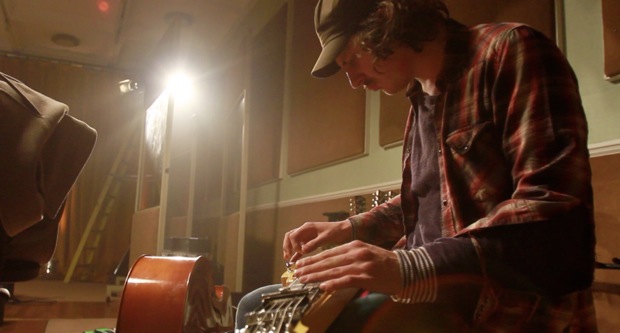
Well after I finished college, I obviously didn’t have any money, just loads of student debt. Some of my friends who were doing quite well in bands said, “You know loads about guitars; why don’t you go with that?” I didn’t know loads, but more than anybody else, and that was really only because I’d played them for so long. When you don’t have any money and your guitar breaks, you just get in there with a screwdriver and try to fix it. And so some friends asked if I would come on the road and help with their instruments and play some. That’s how I ended up doing guitar tech and work.
So I’ve done that on and off every since really. It’s how I’ve been engrained into so many other bands. I met Mumford and Sons through the Brighton music scene and other musicians who knew them. I got a phone call from a friend one day who I used to play football with…“soccer”…who asked what I was doing one summer. He told me he was working with a new band and he needed some help. I figured it always good to make a bit of extra money, and that band ended up being Mumford and Sons. The first gig was a pub show. It’s been pretty crazy since.
It’s nice that they did so well because the only reason I can be here is because I work for them. It’s been good and fun, and tiring. They’re really nice guys. They get me involved as much as they can, and they’re really supportive of me wanting to do my own thing. It’s a real family.
So how did you get to Nashville?
I’ve been in Nashville a lot with Mumford and Sons, and that’s kind of how I got here. Ross, who plays fiddle for Mumford, and Matt who plays some banjo, introduced me to a bunch of people in town. I came here for a vacation last year while I was traveling, and we ended up hanging out and making music. And I decided that I wanted to spend more time here.
I’m going through a rigid immigration thing right now to make it more permanent. I really like spending time here. I’ve never experienced a music community like it. As much as it’s lovely to be a part of the community in Brighton, it’s tough to crack the industry side of things there. It’s really competitive, especially in London if you want to get serious. But here, it’s not like that at all here. It’s easy to get people to play with each other and write with each other. I don’t think there’s a better place to be if you want to make music.
I’m glad you like Nashville! So why did you pick the name Albatross?
Well, I love Fleetwood Mac. I’m a massive Fleetwood Mac fan. So that’s where Albatross came from.
But the idea of picking a moniker made sense because of the nature in which I perform. The majority of the time I perform solo. People who come to see me know that it’ll be me, but not with a rigid group of other people. Luckily I get to play with some of the best musicians in town. I recorded with a bunch of people on Out From Under. It’s whoever I can get to play with me.
Who helped with your album?
I have Mumford’s horn section on my record, their front-of-house guy plays banjo, and Ross plays fiddle. That can make up one band. And it’s been the same in other scenarios on tour when I’ve borrowed other people from bands.
You’re a multi-instrumentalist, right? What instruments do you play?
Guitar is my main thing. But I also play dobro, lap steel, banjo, bass, drums, and ukulele. I play a bit of keys. I’m pretty bad at the mandolin. I wouldn’t say that I play that mandolin… I’m kind of into everything.
I think that as a songwriter, you can understand a song much better if you understand all of the elements that contribute to it. For years, all I wanted to do was get really, really good at electric guitar. It’s very easy to get locked into the mindset of, “It’s all about the guitar.” But in the end, I don’t think that was my soulful perspective of music. I’ve always thought it was something bigger. And I just love songs.
I started playing acoustic instruments when I toured because they’re much more interesting to play in a situation where you don’t have amplification or you’re playing solo. I like the subtleties of music rather than being ostentatious.
I really loved your lyrics on your EP, especially “Puppet on a String,” so I wondered what inspired those lyrics?
I find myself writing literal lyrics about stuff that happens a lot. I feel like I only have something to write when I have a point. In many ways, I think I use writing to try to understand and process my own feelings about a situation. But they’re never supposed to be a hang-up or depressing. They’re always supposed to come with an air of “We’re all in it together.” I think that helps me because I know I’m not the only one, and that’s what would make it endearing to someone else. There’s a really good Dr. Dog song and the chorus goes, “We’re all in it together now as we all fall apart, swapping little pieces of our broken little hearts.” I love that. I’m a hopeless romantic, I guess. I don’t try to write songs about that, but that’s just what comes out. I’m quite sensitive.
But I do also like writing from a third person perspective, as if you’re overlooking someone from a neutral perspective, or when you’re trying to examine yourself from a neutral perspective.
“Puppet On A String” in particular was more overlooking someone else and being concerned for them because they didn’t think they could be themselves, even though they were a beautiful person. That song was about trying to look out for someone.
So what’s next for you? Are you trying to get on board with a label?
I’ve already got another record done and finished. Its songs were written over a very long period of time while I was touring but not having time to record.
Music is the one thing in my life that makes sense. It’s the one thing that makes me happy. So I’m wary to get on with a label because I don’t want that one thing to be something that isn’t mine and become something that I can’t find sanctuary in anymore. If it comes, it would be great to be able to make a living making music. But I would want it on my terms as much as it could be.
But you can’t try to predetermine that stuff. You just have to be yourself, and if people like it, that’s great. You try to do it in an organic way where you can keep it as that. I’m not very good with compromise. Not that I don’t want to see things from another point of view, but in terms of how I want music to make me feel…that’s not something I’m willing to bend on. If you just keep writing songs and people like them, then you can’t fail. I’m not doing this expecting riches. I’m just doing it because I love it.

Caroline McDonald
After dabbling in many parts of the music industry—recording studios, PR, management, labels, publishing—I’m expanding into music journalism because I’m yet to find anything more rewarding that finding and sharing new music.
A longtime sucker for girls with guitars, my musical taste unabashedly follows the songwriting lineage of Dolly Parton and includes Patty Griffin, Gillian Welch, and Neko Case. But not to pigeonhole myself, my music love is big love that stretches from R.L. Burnside to Animal Collective to Lord Huron.
I’ve recently moved home to Nashville after living in Boston and Big Sur for several years. I’d forgotten how music pours onto the streets ten hours a day, seven days a week. I’m honored to share the creative explosion happening here. If your band is in the area or of the area, please reach out!
Latest posts by Caroline McDonald (see all)
- Interview – Roadkill Ghost Choir - July 11, 2014
- Featured Artist: Breanna Kennedy - June 19, 2014
- We Interview crash At Nashville’s Ryman Auditorium - June 14, 2014


