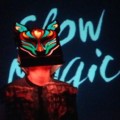
Austin – “I hope I made you uncomfortable,” said Mick Jenkins, catching his breath after shouting his way through “Treat Me Caucasian.” The audience whooped. “I hope I got you thinking,” he continued. But he was preaching to the choir here. Holy Mountain never closes the big garage door that opens onto the patio, and nobody was there on a Tuesday, on one of Austin’s rare 30 degree nights, who didn’t know what they were in for, judging from how many could sing along with, “All in yo’ hood with my hoodie on, Skittles and tea, I’m like fourteen, treat me Caucasian.”
Having said that, something unsettling was happening, not exclusively sourced from poignant lyrics dipping into the perspective of Trayvon Martin: it was completed by the regular flow of police cars in and out of the garage across the street—what a coincidence the Austin PD is headquartered a block away—and by the rustle of young Black men peering nervously at the strobing lights of a police cruiser just down the street. It’s probably not unusual, this being a bar neighborhood, and a productive spot for staking out drunk drivers. But it’s hard not to think about these things, coming off the year that these things happened.
Okay, but now I should stop before belaboring this: Mick Jenkins has a point he’s deadly serious about, and as shown above he’s not shy about the political. But on his latest mix tape, The Water[s] (via Cinematic Music Group), the political is only approached through the personal. The Water[s] is a concept mix tape, autobiographical, confessional, and a metaphor concerned with water as spiritual sustenance, cleansing, and, a little more cryptically, maturing. Appropriately, the beats are minimal, placid, and sound like they’re being heard underwater. Often they do little more than emphasize Jenkins’ vocals. Other times, they create that weird feeling you got from “Swimming Pools” of a jam that’s actually talking about some pretty dark stuff.
For an example of the latter, see title track “The Waters.” It’s addressed to the materialism of mainstream hip-hop, and unsurprisingly suggests water as a replacement for ostentatious consumption. “Water more important than the gold…everybody do it for the gold, people save your souls”, he raps. “The Waters” has the kind of intuitively great beat that lets you tell your parents convincingly that you weren’t paying attention to Jay-Z’s lyrics, just his music. The dark three-chord synthesizer has melodic appeal, but it’s the 808’s and snares that make this. It gives Jenkins a chance to show off the speedy, fluid rapping he’s capable of. Easily, this is the most essential song to hear live.
For whoever found the water metaphor a little inscrutable on first listen (cough cough) Jenkins prefaced the set with a kind of reader’s guide. “I went through some tough times, and I realized I had to grow up.” Okay, good enough to get the gist. Still, it’s a relief that Jenkins’ lyricism can have compelling meanings even when you don’t fully get what’s going on at its core. Converse to the earnestness of “The Waters,” “Martyrs” is deeply, pleasingly sarcastic. Best example: “N***a, I’ma fuck yo b***h, I’m just wit my n***as hanging,” volleys to “Hanging on for dear life, hanging on for dear life, don’t that shit sound funny?” The beat is more cacophonous, though less danceable, with significant vocal samples on the hook and really turned up snare drums. Given its biting conceit that seems appropriate.
While the above stood out live, perhaps The Water[s] most affecting song is more representative of what to expect. “Vibe” plays a little trick on you—this is a song about smoking weed, and it opens with a mellow hook and innocuous lyrics, an atmosphere that promises a spacey, pleasant three minutes of music. But then a woman’s voice comes in, asking for relief from emotional pain. Pretty quickly this song becomes about the anodyne effects of pot protecting the rapper from a world where “Our Bill of Rights from the past will never make it to the future, Even with a Martin Luther, fifty shades of Kama Sutra, We’re fucked, so would you smoke with me? I know this shit has bee stressful, but would you cope with me?”
“Drink! More! Water!” is Jenkins’ slogan, shouted at every opportunity for the crowd to shout back. The refrain would seem pushy if he weren’t so earnest about it. His message has become a little sharper—spiritual fortitude, perseverance, simplicity, immersion—and I’m starting to think that it’s flexible by design. Well, he got his wish: I’m thinking about it.
This is a great show, and a compact review can’t do justice to it. Mick Jenkins has just a few more dates coming up, unfortunately. If you’re at SXSW, Boston, or Salt Lake City in the next month or so, try to make it over. Otherwise, definitely give The Water[s] a listen.

Will Jukes
Latest posts by Will Jukes (see all)
- Dawes Matures With “All Your Favorite Bands” - June 2, 2015
- Communions Find Balance in New EP - June 2, 2015
- Wolf Alice Takes Austin Back to the 90’s - May 27, 2015