
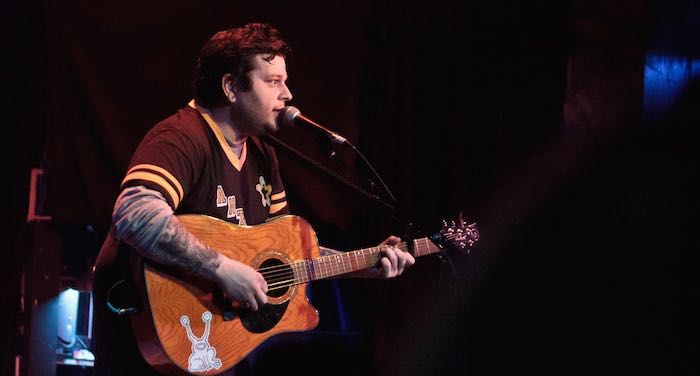
Chicago – On a cold Sunday night, hoards of teenagers and twenty-somethings packed Reggie’s Rock Club in Chicago to see FrnkIero AndThe Cellabration. Concertgoers cheered, whistled, and clapped… but it wasn’t Frank Iero who was getting the love (although he surely would later). They were falling hard for The Homeless Gospel Choir. THGC is Derek Zanetti’s one-man acoustic show. The 31, soon to be 32-year-old, Pittsburgh folk-punk singer-songwriter had the room laughing loudly to “With God On Our Side” and going wild with “Armageddon,” off 2014’s I Used To Be So Young (A-F Records). Between songs and rants, Zanetti chatted with the crowd about his struggles with bipolar disorder and how both punk music and his wife saved him by pushing him to accept, love, and be true to himself. By the crowd’s reactions, it was clear his words and messages resonated with many fans.
Zanetti introduces song after song with, “This is a protest song,” but his humor goes beyond stage banter. Whether he’s singing about religion, war, politics, racism, or sexism, THGC uses sarcasm to tackle serious issues and infuses social commentary with positive messages in lyrics like, “NPR, Fox News, CNN, and NBC are selling you something / Telling you how to believe / It takes a lot of work to think for yourself.”
Shortly after his Chicago show, Best New Bands caught up with Zanetti while he was driving through the mountains of Utah to get serious with the funny man about his music, metal health, and what he believes we all can do to make the world a better, more magical place.
You’ve said Randy Newman inspired you to write protest songs. When did you first discover Randy Newman’s music, and is there a particular song of his that you gravitate to?
I first found Randy Newman when the movie Toy Story came out. He did the soundtrack to that movie. Then I got into his earlier records and heard a song called “Political Science,” which talks about some pretty heavy issues, but it does so with kindness and even a little bit of joking, making it not so awkward to talk about such heavy political issues. That was really inspirational.
You also found punk music at an early age, right? What were some of the bands that inspired you?
Well, one of the first bands I discovered was Green Day, like in 1994, when Dookie came out, and then The Offspring Smash record came out. And I also had a lot of my friends who were listening to Nirvana and Weezer and things like that, just alternative music that wasn’t necessarily being heard on the radio at that time but became popular. It was really interesting to know that there were kids my age who also felt different and weird, and there was this type of music to make us feel accepted. It was very comforting and very important.
Let’s talk about your album I Used To Be So Young. Your bandcamp page describes this album as your opus; to quote, “It takes an extremely personal look at what it’s like to wake up in your thirties and be staring down the barrel of adulthood without any desire to participate in it.” Can you elaborate on that?
I think sometimes when people reach a certain age in life, they resolve to the understanding that they maybe have to grow up now and maybe they have to be a professional now and they give up on some of their hopes and dreams that live inside their hearts, so that they can satisfy what other people deem “normal” or “acceptable.” I Used To Be So Young is a record that refers to my childhood and refers to how felt when I was young and now as an older man, still trying to put my dreams into motion.
It seems you grew up in a rather religious household, with established “norms.” At what point did you realize you don’t have to live by society’s rules and expectations?
I’m still learning that, even to this day. I think it’s a daily renewal of my convictions and a daily renewal of my understanding.
I found the song “Capitalismo” to be one of my favorites on the album. Can you talk about what inspired this song?
I wrote that song, along with a few other songs, after my brother had passed away in a motorcycle accident… His name was Brian. He was my best friend. My mother didn’t birth him, but we lived together my whole childhood. I called him my brother because he was a member of our family… [The song concerns] the idea that sometimes we fill our lives with a bunch of items and belongings to fight off loneliness. You can have a room filled with toys and treats, new clothes, and a TV with a whole stack of DVDs and still be the loneliest person in the world because those things aren’t going to bring you companionship. The things that really matter are the people we get to meet and the love that we get to share. You came into life with nothing, and you’re also going to leave this life with nothing. I don’t know many things. I don’t know much, but I know you have to learn to be okay with that.
I find it refreshing that more and more people are starting to talk about mental illness, especially those within the music world, like you or Michael Angelakos of Passion Pit. After your Chicago set, I chatted with you briefly about how my dad struggled with bipolar disorder. Do you find a lot fans are connecting with you on the subject?
Yeah, it’s unbelievable. Every night, I would say fifty or sixty kids come up to the table and say, “I struggle with mental illness, as well, and I’ve always felt alone. I never knew how to express my feelings to somebody else, but because you mentioned it, now I feel I have the courage to talk to my family and friends about it in a very open and real way.”
In your book Existentialism the Musical, there’s the line: “Innocence is one of the only things you can’t get back once it’s gone, other than time, and your virginity.” I can’t help but wonder if it’s possible for some people to rediscover their innocence? And perhaps your music could help some people do that?
Well, I think idealistically, yes of course, we can all regain our innocence back, but it’s difficult with something as tender and as gentle as that. When something is lost or taken from you, it’s difficult to be able to look through the lens of life like before you had that taken from you. You could be my friend and come over to my house, use my kitchen, make yourself a sandwich, but if every time you come over, there’s five dollars missing from the drawer, I’m gonna have to put two and two together and stop inviting you over to my house. I can like you. I can even be your friend, but it would be difficult for me to trust you. Trust and innocence kind of go hand in hand. Once you lose trust in something, it’s very, very difficult to gain it back. And I’m not trying to live in a world where I’m pretending to have my innocence or that I can regain my virginity…
I felt there was still some innocence to you, listening to you on stage. Do you not feel you have any innocence left?
Well, yes. I still do. I still chose to look at the world in a very new way… [and] like even if I know you took that five-dollar bill out of my drawer, I can still choose to give you another chance. I want to give everyone the benefit of the doubt.
Is there anything you’d like to leave us with?
Kindness is the only magic that still exists in this world. If we can learn to treat each other with kindness, be fair, and listen to somebody’s story, I think we can still practice magic in this world. I think we’d be better for that.
Derek Zanetti is currently on tour with FrnkIero AndThe Cellabration and Modern Chemistry. You can also catch The Homeless Gospel Choir at SXSW. Visit the THGC bandcamp page for a list of tour dates and to purchase I Used To Be So Young and other THGC albums.

Sarah Hess
After attending The School of the Art Institute in Chicago, Sarah went on to study education at Dominican University, earning a degree in history. When not teaching, writing, or taking in a show, she is most likely to be found with a camera to her eye or hanging out in a darkroom.
You can follow Sarah Hess on twitter at @Sarahhasanh and view her music photography on her website: smhimaging.com.
Latest posts by Sarah Hess (see all)
- The Wild Feathers Check One Off The Bucket List - July 31, 2017
- RY X Captivates Chicago - October 24, 2016
- Four New Bands at Day Three of Riot Fest - September 20, 2016


