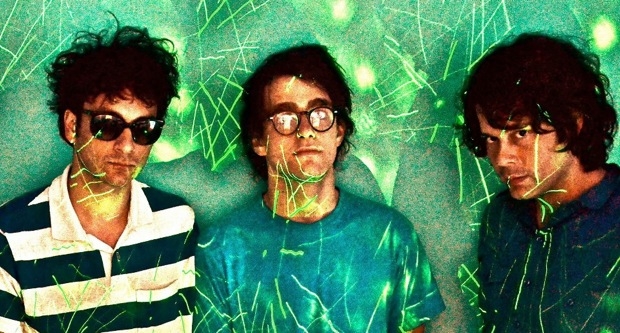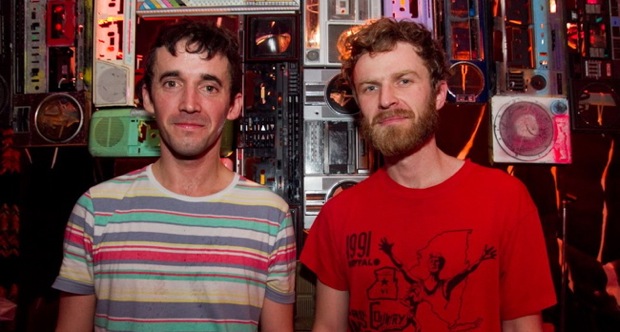
Javelin is Tom Van Buskirk and George Langford, two cousins from Providence, RI who began playing music together in 2004. But unlike many of the mash-up artists of the mid-2000s of which they are often compared, Javelin’s sonic collage of samples are re-assembled and recorded with live instruments—thumb pianos, drums, wooden recorders and anything else they could get their hands on. Javelin’s newest effort, Hi Beams, finds the duo stepping away from MPCs towards more traditional instrumentation, while retaining the bright, dance-infused grooves they’re known for.
Zach Klassen: I know in the past you and George played with a collection of old boom boxes that broadcast your music over radio waves. Is that still part of the show?
Tom Van Buskirk: It is. But it’s in a transformed state. We used to travel with the boxes intact. We took out the tape mechanisms for weight purposes, so we could just broadcast to the radio. But even that got too cumbersome. We had to do a lot of plane travel and it just didn’t seem worth it. So for a while we stopped bringing them, but that didn’t feel right, so I figured out how to take the faces off of them. It’s just the facades—they’re about an inch wide. We put a backdrop up now and they have industrial Velcro on the side and we just zip tie them to a stand and then snap them all together like Legos. They don’t make any noise though. We could put speakers there and jack them all in … it’s sort of a work in progress. We want to get more of them.
ZK: How many are in the collection right now?
TVB: There’s probably 32 or something like that. They all look pretty good but it requires a lot of work to disassemble them and screw them together and make sure all the surfaces are fairly uniform so that they can all snap. It was sort of a weird Moby Dick style madness—I had the idea and then I thought, “What do I have to do to make this happen?” Just chasing the white whale.
ZK: I was always curious if you were playing it over a radio frequency, were you ever in a situation where there were no good available frequencies?
TVB: I think so … I mean we always got the signal to the boom boxes but it was very shaky. It was noisy; there was a lot of hum. It took forever to set them up. We’d set our own stuff up, but then we’d have to plug them all in and dial them into 87.7 or whatever. A lot of times people didn’t even know they were on.
ZK: They just thought it was for decoration?
TVB: Yeah. And that probably went in to the subconscious years later when I was like, “You know what? Just turn them into a visual symbol.”
ZK: So tell me about the writing process for the album you guys just put out, Hi Beams.
TVB: I guess it all starts with conversations George and I have when we’re on the road. We’ll sit in the car and talk about sounds and atmospheres; aesthetic approaches of what we feel are coming next. So, you know, one year that yielded a cowboy album. For this one we thought it would be interesting to actually try and make something fairly cohesive and to be played on stage. Because both of those things we had never even attempted before. Everything is very much like a patchwork and different from the next. We never worried about how we’d play it because when we made a lot of the stuff, some of the older stuff that we still perform today, we didn’t have a set thing that we did live. We showed up and made due. I picked up the bass a couple years ago so there’s a lot of bass on the record because I knew I wanted to play it on stage, which is a real challenge for me, but I love it at the same time. We’ve tried to really give ourselves room to grow on this one, just let the musicality grow, let the writing grow. And we tried to do the same thing with production: allow other people besides us play on the record—we’re kind of control freaks. In the past we never wanted anyone else to touch what we were doing. Even if it sounded worse, we were like, “At least we know how it sounds.” But this time around we were like, “That’s stupid, let’s get other people involved.” The record sounds amazing. If you listen to it on vinyl it definitely sound better than anything we have ever made. Sonically, it is just way better.
ZK: So do you guys have more than just the two of you on stage now?
TVB: It’s just us. But we talk about more members actually. It would be fun to just focus on the performance. I’ve always admired Dan Deacon for what he does—expanding his live show. A lot of people on stage—If you look at Parliament or a band like that—it just multiplies the energy. Every member that you add is a multiplication of interest and energy so I definitely think that it’s in our future.
ZK: Listening to your earlier albums and work, it seemed like you guys were pulling from a lot of different influences. Did you have any specific influences for the Hi Beams?
TVB: Yeah. I guess when it comes to songwriting there were a few approaches. I was listening to the Talking Heads’ Fear of Music a lot and I was reading the 33 1/3 book that accompanies that. It’s by Jonathan Lethem and it talks about his relationship to the songs and his descriptions of what the songs are in a way helped me understand what an album is and how people respond to albums and songs. It’s funny because David Byrne talks about being self-diagnosed Asperger’s.
ZK: Really?
TVB: He’s said that in the past. But he thinks he kind of grew out of it. I’m not saying that I have that, but when it comes to music I just relate to it much in my own way. It’s great understanding how other people interpret music. You get that sometimes from hearing criticism. Although, a lot of times it’s just backsliding around and annoying. But I do love trying to figure out my relationship to music. There are a lot of elements that people get from music that are almost more akin to literature or a movie.
ZK: So you try to expand your viewpoint?
TVB: Yeah, I listen to tones and harmonies and something just hits me. I love it. I think it’s just pretty visceral and emotional with me and has to do with musical relationships. So I guess when we were making these songs, certain things were in my head about what makes a song compelling and what makes the experience of listening to a song with lyrics have more of an impact. So we just decided we are going to try and learn how to do this. We might not be masters—I mean, there’s no way we could be because we don’t have enough experience—but we’re going to try.
ZK: It sounds like it’s challenging, but you guys are getting a lot out of it at the same time.
TVB: Yeah, yeah. The feeling of playing these songs live goes back into the process of writing so when we make the next album, or collection of songs, or mix tape or whatever, all of what we learn on the road this time is going to go back in.
ZK: Speaking of being on the road, it’s starting to be summer festival season. Are you guys playing at any festivals this year?
TVB: We’re going to Europe in June and we’ve got a couple there. One in Chicago in July—it’s called West Fest. We’re also doing something called Sled Island in Calgary. It sounds really cool. And we’ve never been to Calgary, so that’s exciting.
ZK: How do festival crowds compare to club crowds?
TVB: It’s nice. I think everybody is there to have fun and be outside and they might not remember you but it could be a good one-night stand. I like playing in the sunshine, outdoors, with the threat of rain. “What’s going to happen?”… Or fireworks. It’s nice.
ZK: There’s a lot of playfulness and levity involved in your music. I’m wondering if that’s an intentional thing, or are you encountering darker things that you’ve thought about getting into and reflecting in your music
TVB: I ‘d say the play and the levity is in there for good because that’s just who we are and that’s just how we relate to the world. I don’t think we’ll be making music that could be described as dark but what I do strive for more in my own life, at least, is more meaning and significance. There’s more energy in meaning and significance and that was one thing that we were trying to incorporate more. It’s not that instrumental music doesn’t have meaning because it doesn’t have words. It’s not that music that makes you feel good doesn’t have meaning because its light. But at the same time it could be limiting. If you did that forever you would never get anywhere. But yeah, on the new album there are definitely places where we tried to develop our range a little bit more with subject and mood. We’d never made a track like “Nnormal” before. It was a funny thing because we built it from a remix that George had made—the guitar line comes from it. It was a week before we went into the studio and we built that song in a couple days and we were writing the lyrics in the studio and stuff. So that was cool. Seeing what happens when you’re just toying around, playing around and you’re not worried about if it fits in. We both felt good doing it so we were like, “Yeah this is us.”
ZK: Is there any advantage or disadvantage to having someone related to you in a band with you?
TVB: I’d say there are advantages. Greg Fox who is in Guardian Alien, he kind of works with his cousin also, and he had something to say that was really great. It was: “Cousins are like brothers without the bullshit.” And in a way, that can describe George and I. We have our share of bullshit as well but we never get tangled with each other to provoke weird fights and crap like that. But we are close enough that we can sort of telepathically understand each other a lot of the time, which is good when it comes to music. I love my brother too, we get along great but I don’t think I could be in a band with him because you’re just a little too comfortable fucking with that person, you know? (laughs).
ZK: So are you guys living in L.A. and New York now?
TVB: I live in Los Angeles currently but I’m actually moving back east in a couple weeks. I’m moving back to providence where we started.
ZK: Is George going to be with you there?
TVB: He just moved out of Brooklyn and he moved to Western Mass.
ZK: What sparked the change for you guys?
TVB: I don’t know about for him. He has a family. He has a daughter. So I know they were sort of thinking, “What do we want our lives to look like?” Getting a kid into school in NY is kind of crazy. You have to get on a waiting list beginning at age two and stuff like that. But I think life is just more complicated in New York. If you’re up for a complicated life and got tons of energy, financially if you can swing it, it’s a great place for people to be. Speaking for myself in Los Angeles I was just kind of trying it out to see if it would work for me. I too kind of feel like I’m approaching a point in my life where I would like to live in one town for longer than a couple years. I kind of know Los Angeles isn’t that town so I’m hustling back. But it’s funny because sometimes you live in a big city but you’re sort of living a more small-town existence. Our house in L.A., you’d probably find more of them in Portland than L.A.; front yard, back yard, big Victorian, fireplace. We have lemon trees and classic L.A. stuff but we don’t live near any hot shit is going down. It’s comfortable, quiet. It’s sort of like, why are we living a small town existence in a big city?
ZK: Are you going to miss being close the music coming out of L.A.?
TVB: I definitely will. I feel like I get a decent amount of it in my life just from touring. And Providence has an incredible thing going on. It’s totally unique and weird and tiny and fun. I’ll be in striking distance of New York, so I think I’ll probably be more inclined to go to shows when I visit the place, compared to if I lived there. L.A. is kind of exhausting in its own way. Even though, it’s more laid back than L.A. is. New York is just straight up exhausting through and through. You just have to be a little champion. You have to psyche yourself up to get out and experience what the city has to offer all the time. I didn’t really have it in me when I lived there to do it.
ZK: Do you guys do any producing for other musicians?
TVB: We’ve done a little bit, but most of it has been circumstantial or happenstance. But it would be fun to make that part of the game plan and do that.
ZK: Are there any people that you’d specifically liked to collaborate with?
TVB: Yeah. Right now Heems is making a new album. We sent him a couple of beats, south Indian and south Asian-style beats, so we’ll see if he uses some. That would be fun. I like a guy that he signed named Antoine. He’s got a couple great tracks. Anyone who’s up for rapping over something that’s weird. We’ve had a lot of fun remixing people over the years. Some of our best tracks maybe have been remixes. So I know that we definitely have the ability. I’ve always fantasized about the way J-Dilla used to do it. He would collaborate with a whole bunch of people and then everyone would leave for a few hours and he’d be alone in the studio. Then when they came back he would have worked something out that his own creation but made from everything that they had done. You hear similar stories about Phil Spector where the musicians are in one room doing something and they come onto the other and are like “That doesn’t even sound like us. How does that relate to what we were doing?” I guess that’s the kind of producing I would imagine we would do—”Look just trust us. We’re not going to walk everyone through it. We’re just going to see what happens. It’ll be good and it won’t sound like it did before” (laughs). If we could get into that situation I think we could excel (laughs).
Like us on Facebook at BestNewBands.com and Follow us on Twitter @bestnewbandscom

Latest posts by Zach Klassen (see all)
- Real Estate Returns To The Wonder Ballroom - March 6, 2014
- Sera Cahoone Delights Doug Fir With Solo Show - January 29, 2014
- Interview: Peter Michel of Hibou - December 11, 2013