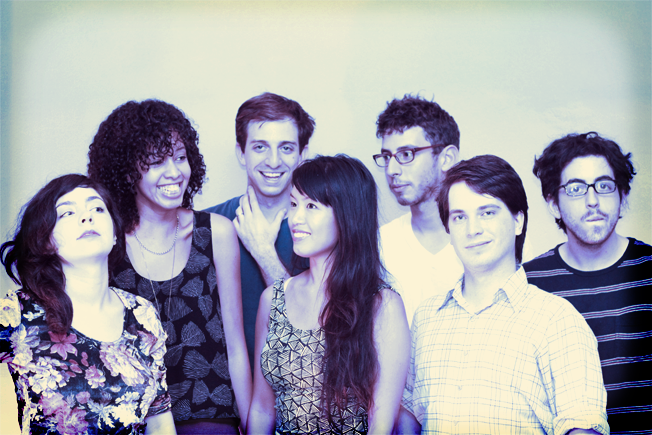
It’s only been a week since catching Ava Luna at Mercury Lounge, and I’ve been jamming out to them ever since. As witnessed during that show, the band seems to have found a great combination of friends and influences to really be a best new and emerging band. Ava Luna is Carlos Hernandez on vocals and guitar, Nathan Tompkins on synthesizer, Julian Fader on drums, Felicia Douglass on vocals and synth, Ethan Bassford on bass, and Becca Kauffman on vocals. It all started with Carlos recording under the name Ava Luna, then forming a trio with Julian and Nathan in college. After college, the three reconnected with Felicia and Ethan, and later adding Becca through friends of friends. This organic and ordered process of forming has become a central theme to the soul of the band, as evidenced in our conversation with the 6-piece.
KK: Your sound is a little bit of old meets new, because you have the ’60s girl group doo-wop harmonies, then you have some spazzed-out electronics in there, along with some soul, and a little bit of this and that. Was that the idea from the very beginning, or more like something you just got into the groove of (so to speak)?
Carlos Hernandez: Yeah, I think so. It was an experiment, and I think that was the idea. In the beginning, when we started making vocal harmonies prominent, it wasn’t even as complicated as that. The idea was, what can we do with just a trio of vocal harmonies, plus a single synthesizer? From there, ever since then, it’s kind of been an organic process, as a group.
KK: I know you’ve been asked before about what your inspirations are musically, but what about lyrically?
CH: Quite honestly, the lyrics are very personal and very honest, but I try to orbit around what I’m talking about. That’s about it. Lyrics take a long time just because it’s always difficult to find just the right words.
Julien Fader: And everyone writes their own lyrics.
CH: Oh yeah, of course. Felicia and Becca have sections of songs where they wrote their words, so you should ask them the same question.
Nathan Tompkins: What’s the inspiration for “Ice Level,” I want to know.
Becca Kauffman: Oh, god. I can’t talk about that (laughs). That was my first go at writing lyrics I knew would be heard by other people. It was like pulling teeth. We played this festival in Riverhead, Long Island, where we were like, ‘we have to play song 6!’ which is “Ice Level,” but that’s what we called it before it had a name. We sat around this picnic table eating really bad Chinese food that we got on the main strip of Riverhead, and we were like, we have to play this song tonight, just write some fucking lyrics. And I was like, I can’t! But I worked it out. And I never changed them. They’re all the first lyrics that I ever thought of. I was just very nervous about saying them out loud.
KK: So does the music usually come out first, and then you put the lyrics to it?
JF: Oh yeah, even before the music there’s the order on the piece of paper the music’s on, then the music, then the lyrics.
KK: What about the group dynamic, since there’s so many of you? It seems like you all have a somewhat equal part in how the music comes about.
NT: Well, the vocals are always done separate from the instrumentals, because it’s too hard to work everything out all at once, so those are a little bit more prepared. A lot of the instrumentals just come. Obviously, Julien writes the drum part and Ethan writes the bass part, and they come together organically like that.
JF: Sometimes they do, sometimes they don’t.
Ethan Bassford: Yeah, sometimes Carlos will have an idea for one element, and we’ll try to stack as many elements onto that as we can. We’ll try to split the difference between the original idea and what makes sense. It’s less like this now, because more people play instruments, but in the beginning we would spend a really long time working on a song and not even know how the whole thing sounded because it was like, we were doing our part and the vocals would be doing their part. So Carlos would be the only one who had the whole picture, and we had to take it on faith.
JF: But sometimes it doesn’t come out like the picture.
CH: Actually, you’d be surprised. I think that in most of the cases it came out exactly like how I imagined.
NT: A lot of it is really organic, but for my part of it, I feel most like the antagonist at rehearsal, because, as the synth player, I’m the one who’s trying to program synth patches on the fly, on my little keyboard with one knob, and it takes forever. So I’ll do a lot of stuff at home. I’ll only come up with ideas at rehearsal, and people will be mad at me for taking so long to do that. So synth and vocals are done at home, but for the core instruments it’s a more organic process.
JF: Sometimes we just loop stuff forever and ever. Sometimes it’s really fun and sometimes it just blows.
EB: Yeah, (the album) took a long-ass time. “Wrenning Day” is the oldest one. When did we start writing that? It was at least a year ago.
KK: This is the single off the new album?
EB: Yes, this is off the new album coming out. Tell your friends.
KK: So then were these all songs that you were kind of collecting, or did you sit down like, we are going to write an album now?
EB: It was weird, because one of them we were drilling forever and ever, but they all took different amounts of time to come together. Like, the very last song on the album I think we pulled together in a month or two. It seemed like that was the quickest. “Stages” is also pretty old; we were drilling that one for a while.
BK: We recorded “Stages” and “No F” in the basement.
EB: Yeah, we actually have earlier, way different versions of those songs.
JF: The split to me, was that there was another drummer. I was in the band, a long, long time ago, and then I quit. Then someone else was in the band, and he quit, and then I rejoined in October of 2010. So for me, when I came in, they were all new. So, I think there was a certain point where it seemed like, we were kind of starting from the beginning, because I had to learn them.
NT: Basically, with all eight songs – we don’t really work with collected songs. It’s more like, we gotta make an album. And with Carlos, one of his things is to have the track order, and have a narrative trajectory. So it was like, the first song is gonna have this energy level, then it’s gonna become this, so like, one through eight, we already knew what that was going to be, and all those songs were that, it’s just that it took a really long time to do it. So, it seems like it was collected songs over a year, but really we were making an album for the entire year.
BK: Yeah, each song always had a place from the very beginning, as a part of a whole.
JF: But we did change the track order, after all that.
EB: After literally talking about songs by number for over a year.
JF: After conceiving it, rehearsing it, and recording it in order, we then changed it all at the very end.
KK: So order is very important.
JF: The order was very important, and at the last second we changed it.
CH: That’s another thing about our band. Whenever we sit down to write, it’s like, this song is going to be super catchy, and people are gonna get into it. Then they usually end up being the weirdest sonic odysseys.
NT: A lot of it was that we thought we had these darker, more obscure songs that we thought should go in the middle of the album, but then the feedback we got from people was that they should go more up front.
CH: Yeah, I think it was a good choice. The songs that were in the middle that are now in the front are the more natural ones, the ones where we weren’t like, oh, we’re going to make a jam. They’re weirder and darker, and I figured it would be inappropriate to start an album that way, but it turns out, that was the most natural thing, and I think it worked out really well.
NT: I just want one review that is like, this album is awesome – except for the track order.
KK: How do you order the set list?
BK: Julien and I have a magic set list that we came up with in Houston.
EB: This was mid-tour, by the way.
JF: It was in like, the first week and a half.
BK: It’s like making a mixtape. The first song is always interesting. When I approach a mixtape I either want the first song to just really hit you hard, or I want it to glide into a whole new scene. So, we experimented with both. We usually start with “Calculus.” That glides.
JF: But it’s still subject to change, depending on how everyone feels. Or if I remember to start the right song.
NT: Right now it’s mainly songs off the new album, with just a couple older songs thrown in, and we generally play it the same way every show for now, until we work out some alternatives.
BK: It’s hard – we had all these ideas for orders, and other songs that we want to bring back into the set, but there’s no time to actually rehearse them, because you have just enough time to sound check half of a song and then you’re done.
KK: Are you guys ever spontaneous during your show?
JF: We brought back one old song that we haven’t done in a long time. I was really proud of that.
BK: Did we do that on the spot? That was so fun. That was in Omaha, and there was like, 12 people there.
JF: And I daresay, we nailed it.
KK: What am I in store for tonight?
JF: Good stage banter. That’s the most spontaneous thing you’ll find.
EB: It’s been a pleasure to watch Carlos’ stage banter evolve. On the last tour it was really easy, because we could legitimately say, ‘this is our first time in this place,’ and everyone would be like, ‘wooo!’
Felicia Douglass: Now this is our third time playing at Mercury, we’re so pumped.
JF: But that totally didn’t answer the questions at all. What are we going to do tonight?
BK: Well, Ethan, did you print up the set list at work?
EB: Oh god! I didn’t print up the fucking set list!
BK: Ohhhhh!!
EB: I had the best set list! I was going to have it printed out all nice, and I had great joke titles for every track. Next time, next time.
BK: Usually we just have these ripped up papers with the set list scrawled on it. I was really looking forward to having these crisp, 8×11 sheets of papers laid out in bold print.
EB: An of course I neglect to do so. Oh well, life is full of fucking disappointments.
KK: What are you guys all listening to right now?
CH: I could listen to the Ty Segall album like, 70 more times.
EB: Cate Le Bon, we listened to in the car.
JF: We listened to a ton of CAN on tour.
NT: Definitely Suuns, as far as new bands. We all really like Suuns.
JF: I listened to all 12 Starflyer 59 albums.
EB: The thing in Portland – Pure Bathing Culture. It’s brand new; I don’t even think they have anything recorded yet. It’s people from Vetiver and some other thing. They’re really good.
BK: Twin Sister.
JF: Tremors II! We saw this band last night called Tremors II, and they were so good.
KK: Okay, last question: What are you guys most proud of to date?
EB: I definitely nerded out a little to see a vinyl that we made, pressed into actual physical form. I think that’s pretty amazing.
BK: I’m proud that we’re all friends.
EB: That actually is kind of miraculous when you consider we were just on tour for a month, and nobody wants to kill each other.
CH: I’m proud that we got to the west coast. I grew up here, and I had never been there in my life. And I was like, well, no one’s gonna give me a plane ticket over there. For me it was like, if I can go to California by playing music, and not have to pay for it, I know that things are good.
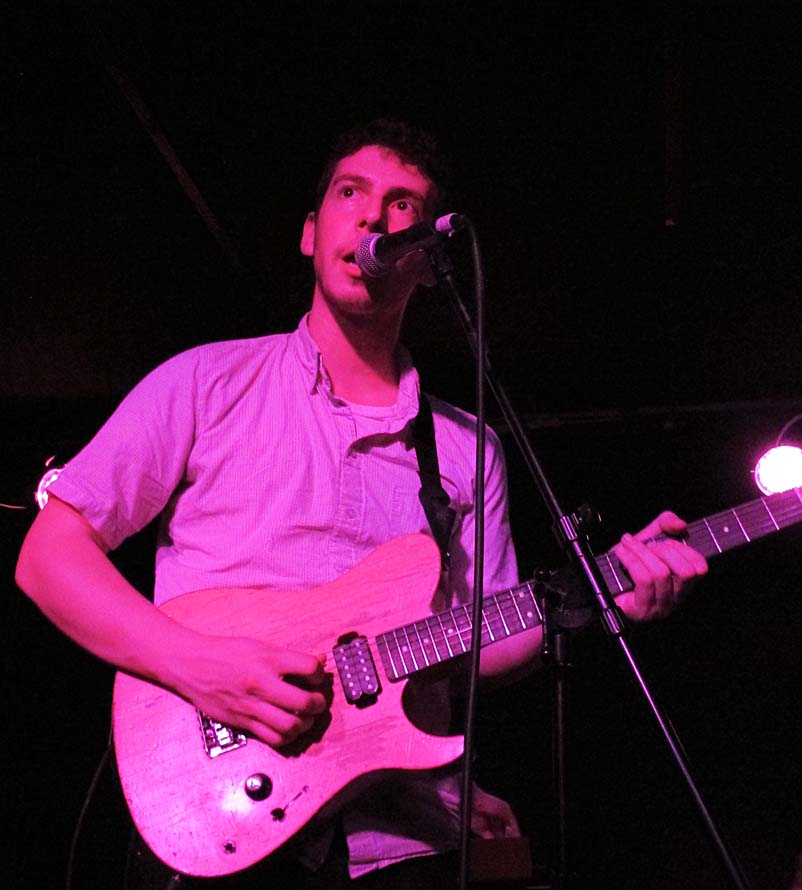
Things are definitely good for Ava Luna. They’re brand new LP Ice Level is out now and available to stream on their Bandcamp, and they are currently on the road playing shows on the way to SXSW. They’ll be back in Brooklyn with more show dates in May.