Amazing things can happen when people from all walks of life come together for a common cause. I witnessed this firsthand Sunday night at the University of Oregon, where the Arab Student Union held its fifth annual Arabian Nights event at McArthur Court. The students managed to bring to the event world-renowned rapper Omar Offendum, whom I’d previously featured in a politically-charged playlist last month.
While I don’t speak Arabic — and neither did some of the Caucasian, African, Latino, Asian and Native American attendees — I learned a lot about breaking down cultural barriers and connecting with people on a personal, universal level. For his part, Offendum has a gift for doing just that, with a mix of scholarly lyrics and street rhythms that no one can ignore.
During the show, Offendum told the crowd, “You gotta know where you’re coming from to know where you’re going, [so] learn your history – it’s a rich one.” With that in mind, I will preface the concert review with a little background info on this multifaceted artist.
After his set, I stuck around to talk to Offendum. My 15-minute interview, however, was lost, thanks to my craptacular iPhone that just loves to make my audio recordings disappear. Nevertheless, I got to learn a lot about Offendum: he was born in Saudi Arabia, raised in Washington, D.C., and spent most of his grade school years at the Islamic Saudi Academy in Alexandria, VA, where his Arabic lessons inherently included the study of poetry. (He later studied architecture in college, and still does some work in that field today.) Transitioning to hip hop came naturally, as growing up in the 90s subjected him to the likes of Run DMC and other rappers of that era, and his verses are full of subtle references to pieces from renowned Arab and American poets alike. Come September 11, 2001, however, some of his audience members would start to question his lyrics and even his patriotism to the U.S. But while he knows that judgmental people will continue to judge, he’s optimistic that cultural understanding and appreciation will continue to grow between Arabs and non-Arabs. (Part of the deal in his coming to the UO included the chance to lead a lecture on poetry in motion, which he did Monday afternoon.)
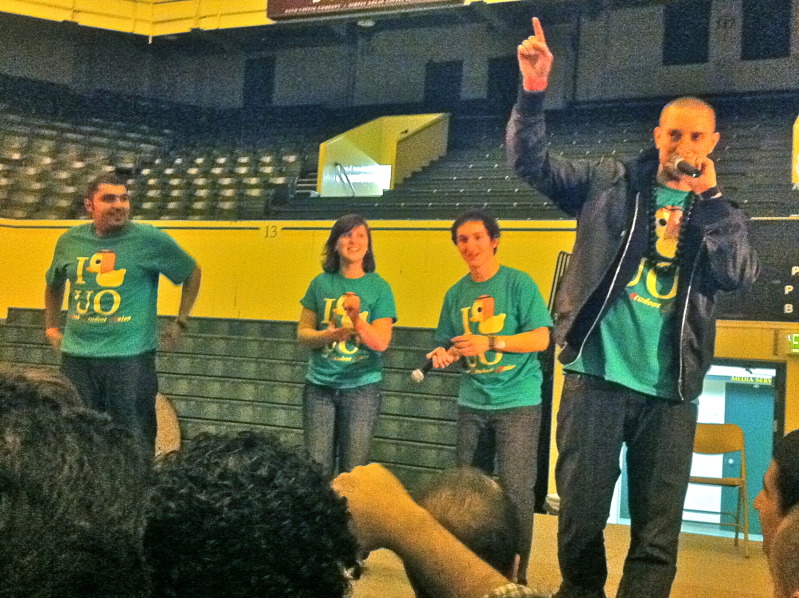
Arabian Nights began with a belly dancing troupe, Arabic tongue twister contests and a skit from the Arab Student Union. Before a delicious dinner of tabbouleh, fattoush and maghrabiyi (couscous and chicken), audience members — myself included — learned how to dance the dabke, a traditional Arab-style line dance.
Sporting an ASU t-shirt, Omar Offendum took the stage shortly after 9 p.m. He encouraged audience members to move away from their tables and closer to the stage. “I know you all just had dinner, but … I’m not gonna bite,” he assured. As we shyly scooted our chairs up to an opening in front of the stage, Offendum began his set with a poem by Langston Hughes, “The Negro Speaks of Rivers.” Fluidly switching between English and Arabic, Offendum noted that “poetry set the foundation for hip-hop,” and throughout the night recited verses from other poets, including “On This Land” from Mahmoud Darwish of Palestine. An original piece of Offendum’s paid homage to hip hop’s urban and street beginnings by way of Straight Street, one of the oldest and most famous streets in Damascus, Syria. (The song is on Offendum’s album, SyrianamericanA, but he performed it a cappella that night.)
Halfway through the show, audience members finally got the nerve to get out of their seats and start grooving to Offendum’s set. I’m assuming they were encouraged by his openness and encouraging demeanor — though we must’ve been a tough crowd at first, he kept smiling, cracking jokes and addressing us as if we were on a one-on-one level. He performed more tracks from SyrianamericanA, still switching between English and Arabic and occasionally offering translations/explanations of some of the Arabic phrases. Yet even to the non-Arabic speakers such as myself, his verses needed no translation: the feelings of pain, frustration, perseverance and hope are universal.
Coincidentally, Offendum has a track on his album entitled “Mother’s Day,” which he performed along with “Destiny,” “Superhero” and title track “SyrianamericanA.” Of his lyrical flow, I will say this: the man is insanely good at what he does. On more than one occasion, my jaw dropped at how fast he was rapping; I’m pretty sure I’ve only ever heard Ludacris and Jay-Z spit rhymes that fast and that clearly pronounced. (Seriously — if my phone hadn’t lost all my audio recordings, I would have evidence of this, but maybe YouTube can offer up some proof for this claim.)
From Damascus to D.C., and from Egypt to Eugene, Offendum gave me a true sense of what it meant to be an Arab-American in the 21st century. His songs brought the current affairs of the Middle East, seemingly so distant and unconcerning from life in America, close to home — not just for the Arab students in the audience, but for me as well. In the interview, Offendum told me that “at the end of the day, hip hop is about keeping it real,” which is exactly what he does. No pretenses, no labels — just honesty, through verses that unite and inspire people of all walks of life.
Omar Offendum will be in Toronto this Friday, May 13, for the Toronto Palestine Film Festival; he’s also active on Myspace, Facebook, Blogspot and Twitter. SyrianamericanA is available online.

Latest posts by Monica Christoffels (see all)
- Weekend Playlist – June 17, 2011 - June 17, 2011
- Weekend Playlist – June 10, 2011 - June 10, 2011
- Sasquatch! in Review: Part Two - June 3, 2011